Psychometric stage
What this stage is
The Psychometric stage evaluates candidates using standardized personality assessments. It supports two scientifically-backed frameworks:
- DISC: Measures behavioral tendencies across four dimensions — Dominance, Influence, Steadiness, and Conscientiousness.
- OCEAN (Big 5): Evaluates personality across five traits — Openness, Conscientiousness, Extraversion, Agreeableness, and Neuroticism.
You can configure the stage to run either assessment or both in sequence.
This stage is available for both assessments and contests.
When to use it
Use the Psychometric stage when:
- You want to understand how a candidate is likely to behave in team settings or under pressure.
- You are hiring for roles where communication style, collaboration, or leadership disposition is critical.
- You need a structured, bias-reduced layer of evaluation alongside skills-based stages.
Common use cases:
- Leadership and management hiring.
- Client-facing or sales roles where behavioral fit matters.
- Team composition and culture alignment during campus or bulk hiring.
DISC vs. OCEAN — which to choose
Both assessments reveal different facets of a candidate's personality. The right choice depends on what you are trying to learn.
| DISC | OCEAN (Big 5) | |
|---|---|---|
| Focus | Behavioral style and communication tendencies | Broad personality profile across five dimensions |
| Question format | Situational choice — pick the most/least fitting response | Likert scale — rate agreement with self-descriptive statements |
| Best for | Roles requiring strong interpersonal or team dynamics | Roles where overall personality fit and trait depth matter |
| Output | Dominant behavioral profile (D, I, S, or C) | Scores across all five dimensions |
You can include both in a single Psychometric stage if you want a complete view of the candidate.
DISC assessment
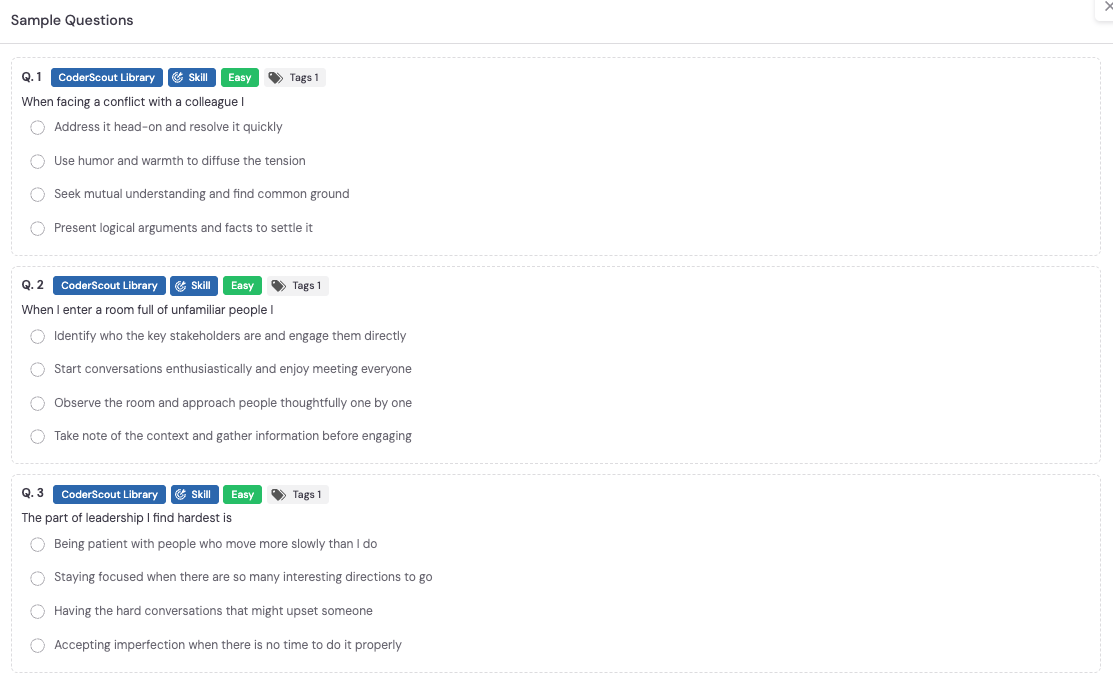
The DISC test presents situational questions where candidates choose responses that best reflect their natural behavior. Each question maps to one or more of the four DISC dimensions:
- D — Dominance: Results-focused, direct, and decisive.
- I — Influence: Enthusiastic, collaborative, and persuasive.
- S — Steadiness: Patient, reliable, and empathetic.
- C — Conscientiousness: Analytical, detail-oriented, and systematic.
There are no right or wrong answers. The assessment captures behavioral tendencies rather than measuring ability.
OCEAN assessment
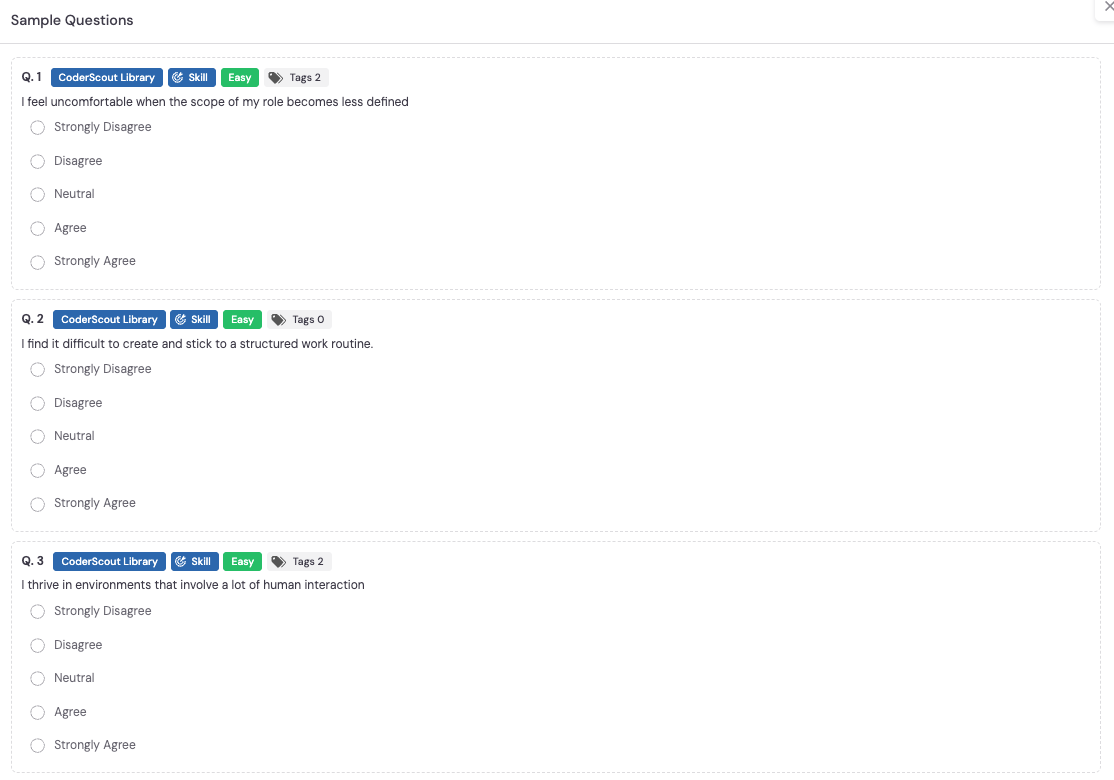
The OCEAN (Big 5) test presents a series of first-person statements, and candidates rate their agreement on a five-point scale from Strongly Disagree to Strongly Agree. Each statement maps to one of the five personality dimensions:
- O — Openness: Curiosity, creativity, and receptiveness to new ideas.
- C — Conscientiousness: Organization, dependability, and goal-directed behavior.
- E — Extraversion: Sociability, assertiveness, and energy in social settings.
- A — Agreeableness: Cooperation, trust, and consideration for others.
- N — Neuroticism: Emotional stability and resilience under stress.
Like DISC, there are no right or wrong answers. The results reflect personality tendencies, not performance.
Configuration
When you add a Psychometric stage, you will see a configuration modal with the following options.
Challenge configuration
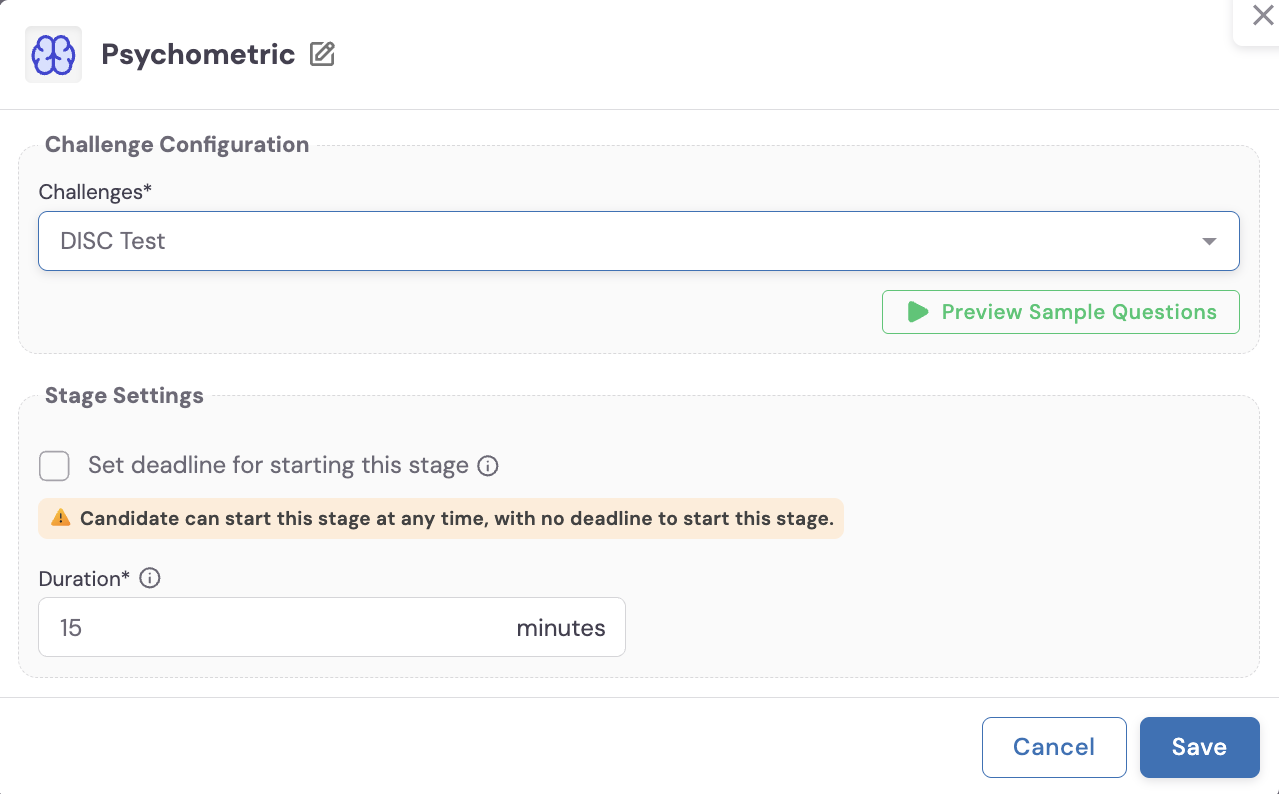
Use the Challenges dropdown to select which assessment to include:
- DISC Test — evaluates behavioral style and workplace tendencies.
- OCEAN Test — evaluates the Big 5 personality dimensions.
- Both — runs DISC and OCEAN assessments back to back.
You can click Preview Sample Questions to view example questions for the selected assessment before saving.
Stage settings
- Deadline to start: Optionally set a date and time by which the candidate must begin this stage. If left unchecked, the candidate can start at any time.
- Duration: Set the time limit for the stage in minutes. The default is 15 minutes.
For a full reference on shared stage settings, see Stage Settings.
Evaluation results
Unlike skill-based stages, the Psychometric stage does not produce a pass/fail score. Instead, it generates a qualitative profile that describes how a candidate is likely to think, communicate, and behave at work.
DISC results
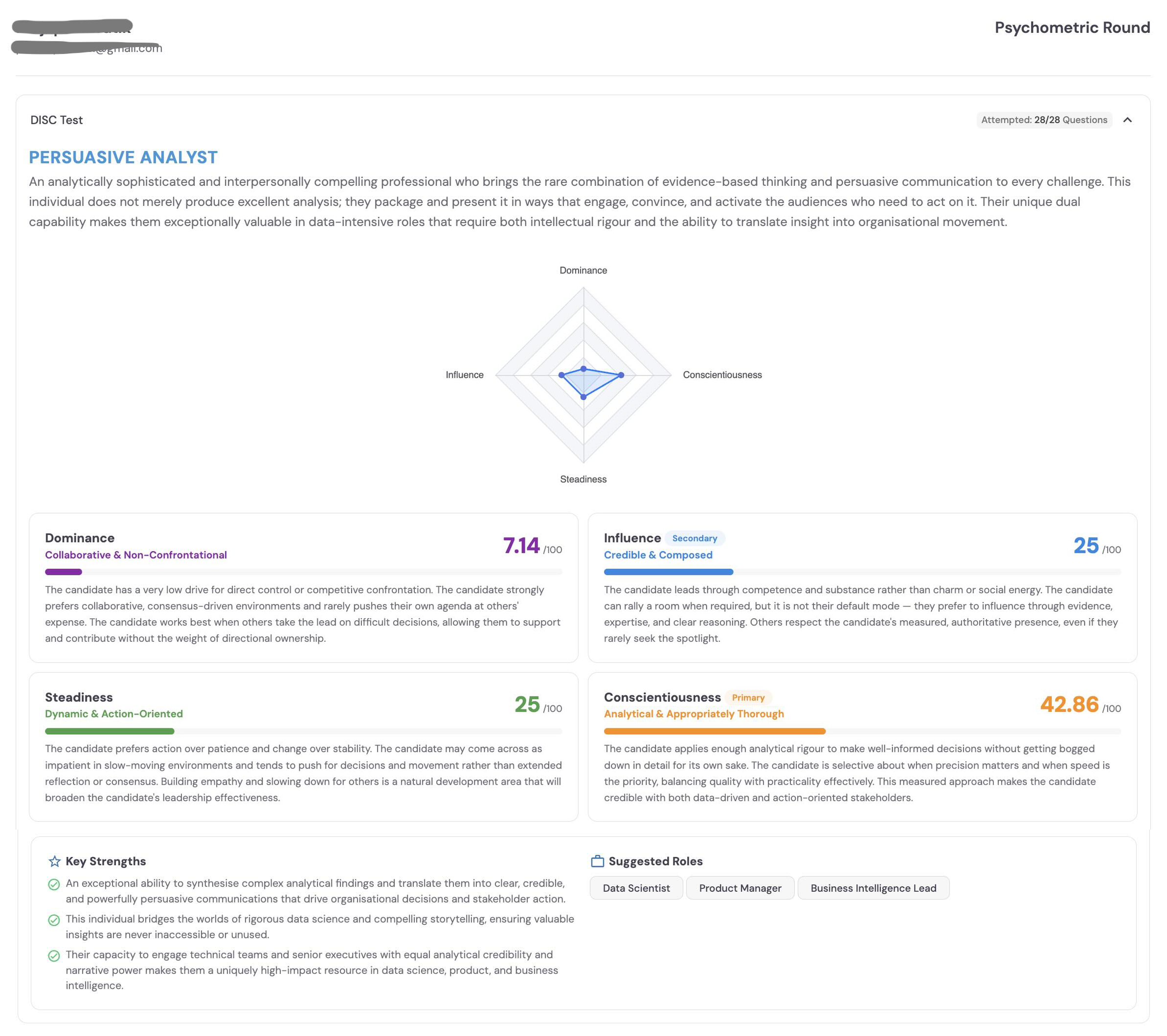
The DISC result includes:
- Personality type label: A descriptive title (e.g. Persuasive Analyst) that summarises the candidate's dominant behavioral style.
- Radar chart: A visual breakdown of scores across all four DISC dimensions — Dominance, Influence, Steadiness, and Conscientiousness — showing the relative strength of each trait.
- Per-dimension scores and descriptions: Each dimension is scored and accompanied by a written interpretation of what that score means in a workplace context.
- Key strengths: A curated list of behavioural strengths inferred from the profile.
- Suggested roles: Role types that tend to align well with the candidate's behavioral style.
OCEAN results
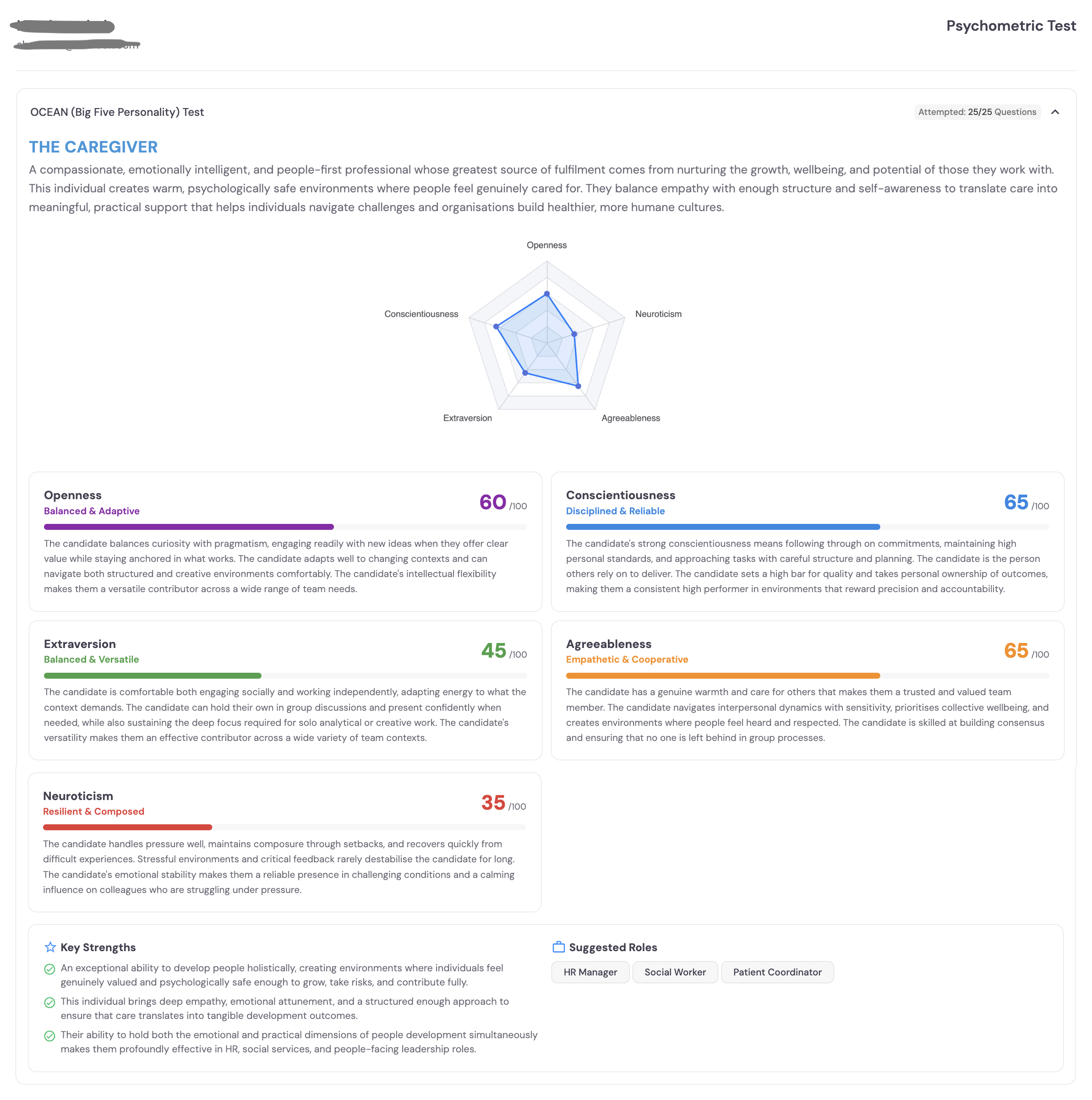
The OCEAN result follows the same qualitative format as DISC:
- Personality type label: A descriptive title (e.g. The Caregiver) that captures the candidate's overall personality archetype.
- Radar chart: A visual breakdown across all five Big 5 dimensions — Openness, Conscientiousness, Extraversion, Agreeableness, and Neuroticism.
- Per-dimension scores and descriptions: Each trait is scored out of 100 and paired with a written interpretation of how that trait manifests in a professional setting.
- Key strengths: Behavioural strengths derived from the candidate's overall profile.
- Suggested roles: Role types that align well with the candidate's personality makeup.