CEFR Stage
What this stage is
The CEFR stage evaluates a candidate's English communication proficiency using the Common European Framework of Reference for Languages (CEFR).
It is designed for hiring workflows where language ability needs to be measured in a structured and standardized way before the candidate moves forward.
The stage evaluates candidates across six areas:
- Reading
- Writing
- Speaking
- Listening
- Vocabulary
- Grammar
This stage is available for both assessments and contests.
When to use it
Use the CEFR stage when:
- You are hiring for roles where English communication is critical.
- You need a standardized way to assess candidate language proficiency.
- You want to screen candidates on communication ability before interviews or role-specific evaluation stages.
Common use cases:
- Customer-facing and support roles
- Sales and business communication roles
- Content, training, and communication-heavy roles
- Hiring pipelines where spoken and written English proficiency must be validated early
How CEFR-based evaluation works
When configuring the stage, you select the target CEFR level for the role. The selected level determines the overall difficulty of the questions presented to the candidate.
For example, if the stage is configured at B1 - Intermediate, the candidate will receive questions aligned to that level of expected proficiency.
The candidate is then evaluated across:
- Reading
- Writing
- Speaking
- Listening
- Vocabulary
- Grammar
Each area contributes to the overall stage score and helps create a more complete picture of the candidate's communication ability.
Configuration
When you add a CEFR stage, you will see a configuration modal with the following options.
Challenge configuration
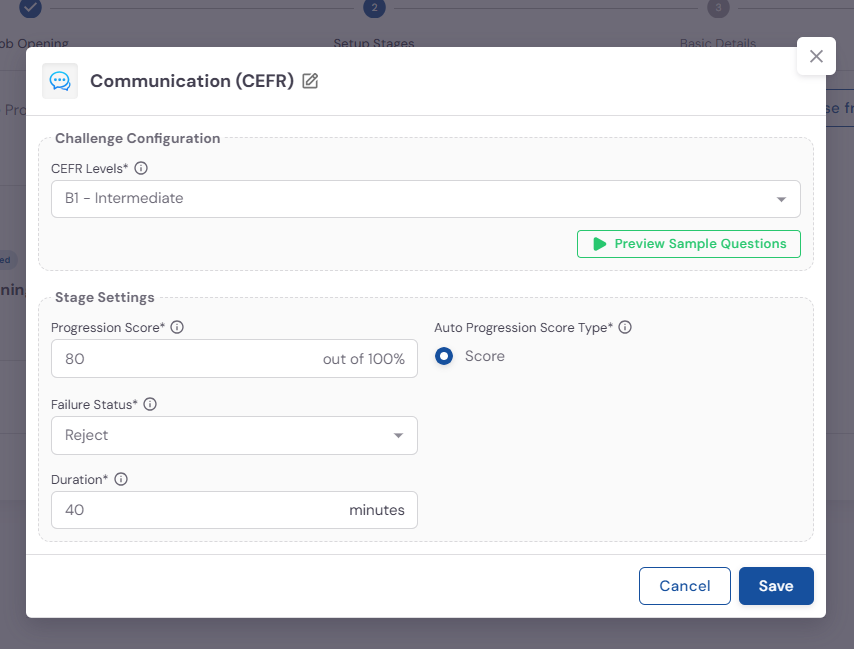
Use the CEFR Levels dropdown to select the language proficiency level expected for the role.
The selected level controls the difficulty of the stage questions.
You can click Preview Sample Questions to review example questions before saving the stage.
Stage settings
- Progression Score: The minimum score required for a candidate to qualify for the next stage.
- Auto Progression Score Type: Defines the score type used for progression. CEFR progression is evaluated using Score.
- Failure Status: The status applied when a candidate does not meet the configured progression criteria.
- Duration: The total time allowed for completing the stage.
Each CEFR stage attempt consumes 2 credits per candidate.
Progression behavior
If the candidate meets or exceeds the configured Progression Score, they can move to the next stage.
- If auto progression is enabled in the assessment, the candidate is automatically advanced to the next stage.
- If auto progression is not enabled, the candidate's status is updated based on the configured workflow behavior and can be reviewed manually by the hiring team.
- If the candidate does not meet the required criteria, the configured Failure Status is applied.
This allows teams to use CEFR either as an automated screening layer or as a controlled review checkpoint.
Evaluation results
The CEFR evaluation page gives recruiters and hiring teams a structured view of the candidate's overall communication ability and skill-wise performance.
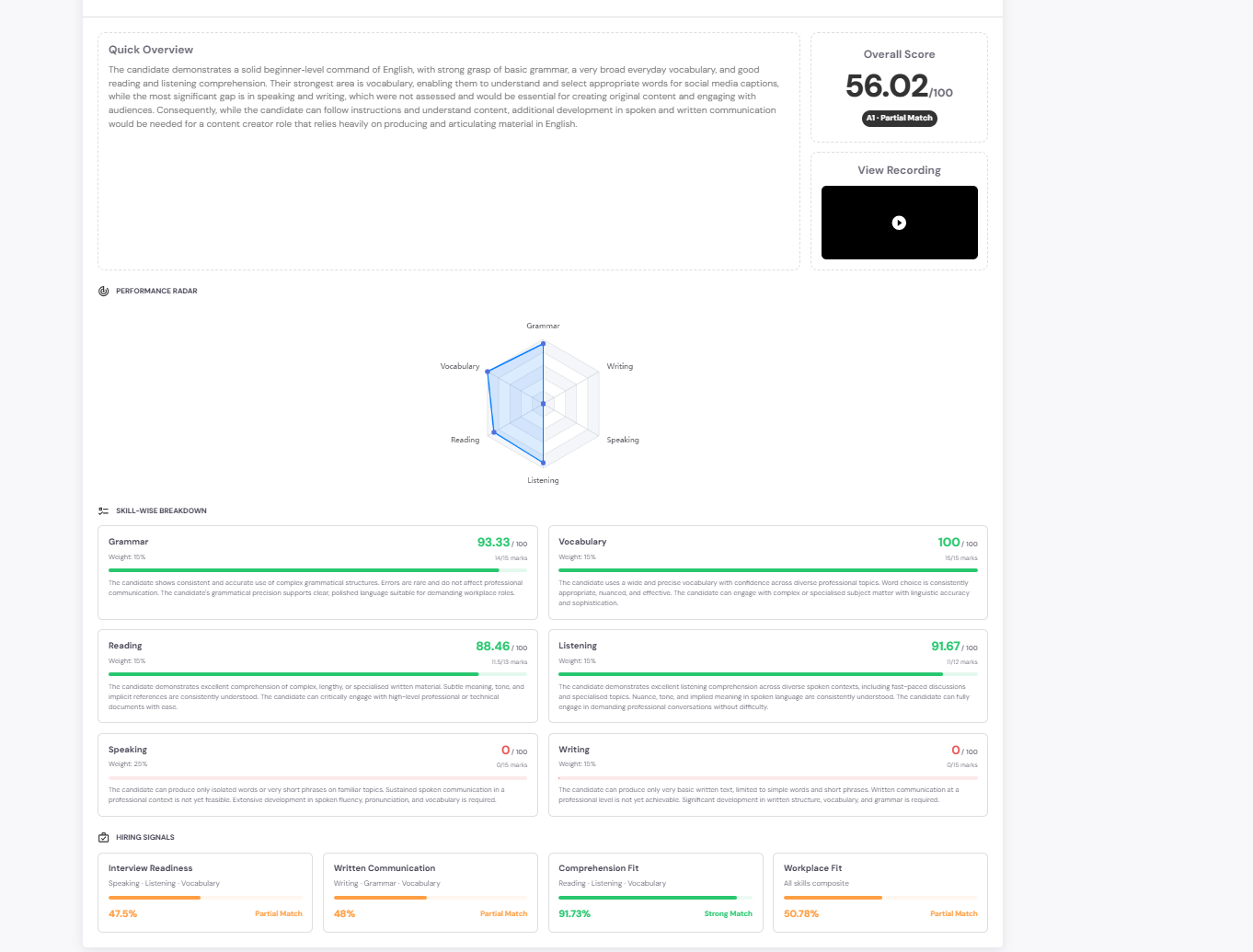
The evaluation includes:
- Quick Overview: A written summary explaining the candidate's overall proficiency, strongest areas, weakest areas, and practical suitability for communication-heavy work.
- Overall Score: A consolidated score out of 100 representing total performance across the assessed language dimensions.
- Performance Radar: A visual breakdown across Grammar, Writing, Speaking, Listening, Reading, and Vocabulary.
- Skill-wise Breakdown: Detailed scoring cards for each language area with marks, weighted contribution, and a written interpretation.
- Hiring Signals: Composite indicators such as interview readiness, written communication, comprehension fit, and workplace fit.
- View Recording: A recording view for reviewing candidate responses and evaluation context where available.
What recruiters can learn from this stage
The CEFR stage helps teams answer questions such as:
- Can the candidate understand written and spoken English at the level required for the role?
- Can the candidate communicate clearly in writing?
- Is the candidate ready for customer, collaboration, or interview-heavy workflows?
- Does the candidate's communication ability justify moving forward to the next stage?
This makes the CEFR stage especially useful in workflows where communication skill is a hard requirement rather than a secondary trait.