Why Interviews Alone Can't Predict How Someone Will Perform on the Job

Introduction
You did everything right. Three rounds of interviews. A panel that included the team lead, the VP, and a cross-functional stakeholder. The candidate was articulate, confident, and checked every box on paper.
Six months later, they've missed every deadline, clashed with the team, and you're back to square one — wondering what went wrong.
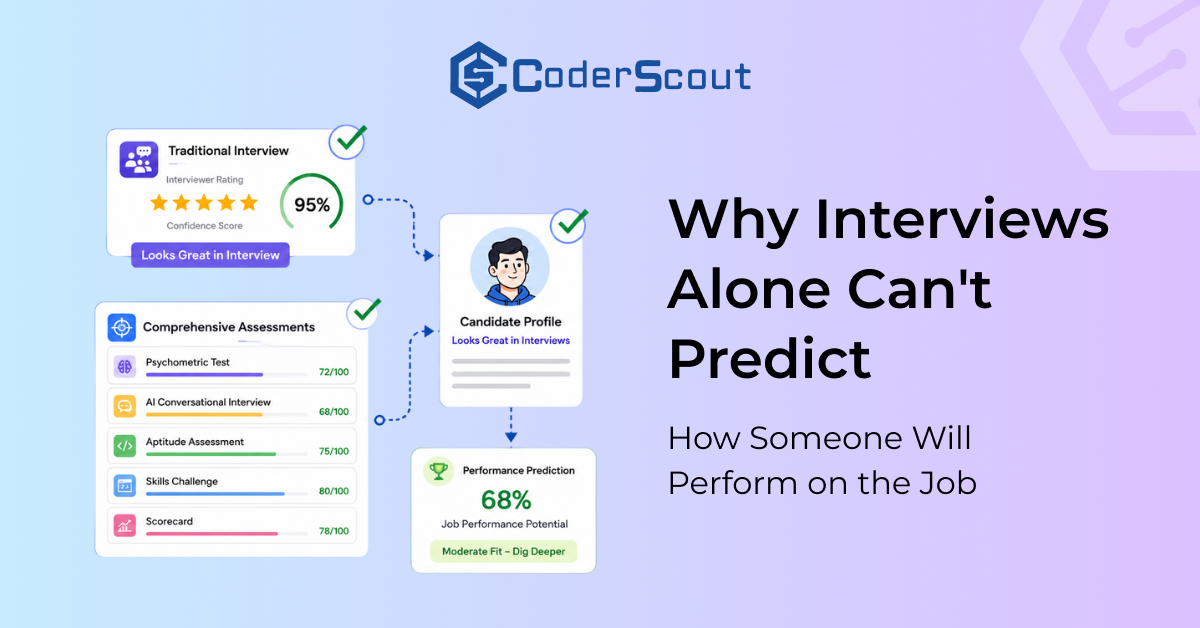
If this sounds familiar, you're in good company. It happens everywhere, every day. And the uncomfortable truth is this: interviews, no matter how well-designed, are a terrible predictor of actual job performance.
Research from the landmark Schmidt & Hunter meta-analysis (1998) found that unstructured interviews predict job performance with just 14% accuracy — barely better than a coin flip. Yet most companies still rely on them as the primary - and often only - hiring tool.
This post breaks down why interviews fall short, what the research says actually works, and how to build a hiring pipeline that predicts performance — not just interview confidence.
The Problem: Why Traditional Interviews Fall Short
1. Interviews Measure How Well Someone Interviews - Not How Well They Work
The most articulate candidate in the room is not always the best performer on the team. Interviews reward communication confidence, preparation, and social fluency — valuable in some roles, but rarely what determines success in most.
I've seen it happen countless times. A developer who stumbles through a verbal explanation but writes clean, efficient code every day loses the offer to a smooth-talking candidate who can barely debug a simple function. An introverted analyst with exceptional data intuition comes across as less impressive than a charming candidate who fumbles with Excel.
Interviews measure interview performance. Not job performance.
2. Cognitive Biases Creep into Every Interview
Interviewers are human - and humans are wired with cognitive shortcuts that distort judgment, often without realising it.
- The Halo Effect - A candidate makes a strong first impression, and everything they say afterward is interpreted through a positive lens.
- Affinity Bias - Interviewers unconsciously favour candidates who remind them of themselves in background, communication style, or personality.
- Recency Bias - The last candidate interviewed is evaluated more favourably simply because they're the freshest one in memory.
- Confirmation Bias - Once an interviewer forms an early opinion, they seek evidence that confirms it rather than challenges it.
Experience doesn't fix this. Senior interviewers are just as susceptible. The only real fix is structured, standardised evaluation — which traditional interviews, by their conversational nature, rarely provide.
3. Candidates Are Performing, Not Revealing
Let's be honest — modern candidates are coached, rehearsed, and prepared. They know the STAR method inside out. They've practiced every "tell me about a time when" question. LinkedIn is full of interview prep content, and most candidates consume it thoroughly before meeting you.
This isn't dishonest - preparation is smart. But it means the person you meet in the interview room is a polished, practiced version of the candidate — not an accurate reflection of how they'll perform under real working conditions.
What they say they would do in a hypothetical situation and what they actually do under pressure are very different things.
4. Interviews Don't Test the Skills the Role Actually Requires
A backend developer is asked, "How do you handle conflict with a team member?" A data analyst is asked, "Where do you see yourself in five years?" These questions tell you almost nothing about whether they can actually build a scalable API or write a complex SQL query under a deadline.
Even when technical interviews are included, they're often conducted inconsistently — different interviewers ask different questions, evaluate answers differently, and score candidates against different internal benchmarks. The result is a hiring decision built on unreliable, incomparable data.
5. The Cost of Getting It Wrong Is Enormous
A bad hire at a mid-level role costs an organisation anywhere from 50% to 200% of that employee's annual salary — factoring in recruitment, onboarding, lost productivity, team disruption, and the eventual rehire process. For senior roles, the damage is even greater.
And yet, most companies continue to rely on a 45-minute conversation as the foundation of a decision that will affect their team, their product, and their culture for years.
The Solution: What Actually Predicts Job Performance
The good news is that decades of research in industrial-organisational psychology have identified assessment methods that are far more predictive than interviews alone. A landmark meta-analysis by Schmidt & Hunter (1998), updated in 2016, ranked the predictive validity of various hiring tools:
| Assessment Method | Predictive Validity |
|---|---|
| Work Sample Tests | 54% |
| Structured Interviews | 51% |
| Cognitive Ability Tests | 51% |
| Personality Assessments | 40% |
| Unstructured Interviews | 14% |
The conclusion is clear: combining multiple, structured assessment types dramatically improves hiring accuracy.
How CoderScout Helps You Hire Based on Evidence, Not Gut Feel
This is where the rubber meets the road. CoderScout is built around the idea that hiring should be driven by data, not intuition. Here's how it addresses each failure of traditional interviews:
Psychometric Tests
CoderScout supports two globally validated psychometric frameworks:
- DISC Assessment - Measures behavioural style across four dimensions: Dominance, Influence, Steadiness, and Conscientiousness. Ideal for understanding how a candidate will communicate, lead, and respond to conflict.
- OCEAN Big Five - Evaluates personality across Openness, Conscientiousness, Extraversion, Agreeableness, and Neuroticism. One of the most researched personality frameworks in the world, with strong links to long-term job performance.
Unlike interviews, psychometric tests are standardised, unbiased, and comparable across candidates. CoderScout's AI generates a comprehensive behavioural summary for each candidate — giving hiring managers real insight into how they think, collaborate, and respond under pressure, before a single interview is scheduled.
👉 Explore CoderScout Psychometric Tests
AI Conversational Interviews
CoderScout's AI Interview conducts structured, multi-topic technical conversations with candidates — evaluating reasoning, problem-solving, communication clarity, subject knowledge, and professional confidence.
Unlike a human interview, the AI is perfectly consistent. Every candidate is asked the same questions, evaluated against the same criteria, and scored on the same dimensions - eliminating interviewer bias entirely.
After each interview, CoderScout generates:
- An overall score with a hiring recommendation (Hire / Consider / Pass)
- Scores across Communication, Subject Knowledge, Completeness, Confidence & Tone, and Professionalism
- Topic-wise performance breakdowns
- A full interview transcript with audio playback
This gives hiring teams the depth of a human interview with the consistency and scalability of an automated system.
👉 Explore CoderScout AI Conversational Interview
Aptitude Assessments
CoderScout's AI-generated aptitude tests evaluate logical reasoning, quantitative thinking, and problem-solving ability — all calibrated to the experience level and role requirements you specify.
This directly addresses one of the biggest failures of interviews: the inability to assess cognitive ability under controlled conditions. Aptitude scores are objective, structured, and directly comparable across your entire candidate pool.
👉 Explore CoderScout Aptitude Assessments
One-Way Video Interviews
For roles where communication skills matter — sales, customer success, operations, support — candidates record structured responses to your questions on their own time.
Recruiters can review responses asynchronously, score each answer, and compare candidates side by side - without the scheduling overhead of coordinating dozens of live calls. The result is a fairer, faster, and more consistent early-stage screening process.
👉 Explore CoderScout One-Way Video Interviews
Scorecards
CoderScout's Scorecards consolidate every data point from every assessment stage into a single, downloadable report — quiz performance, coding scores, AI interview insights, psychometric results, proctoring activity, and interviewer feedback.
No more fragmented, undocumented evaluations. Scorecards make hiring decisions transparent, defensible, and easy to communicate across teams.
👉 Explore CoderScout Scorecards
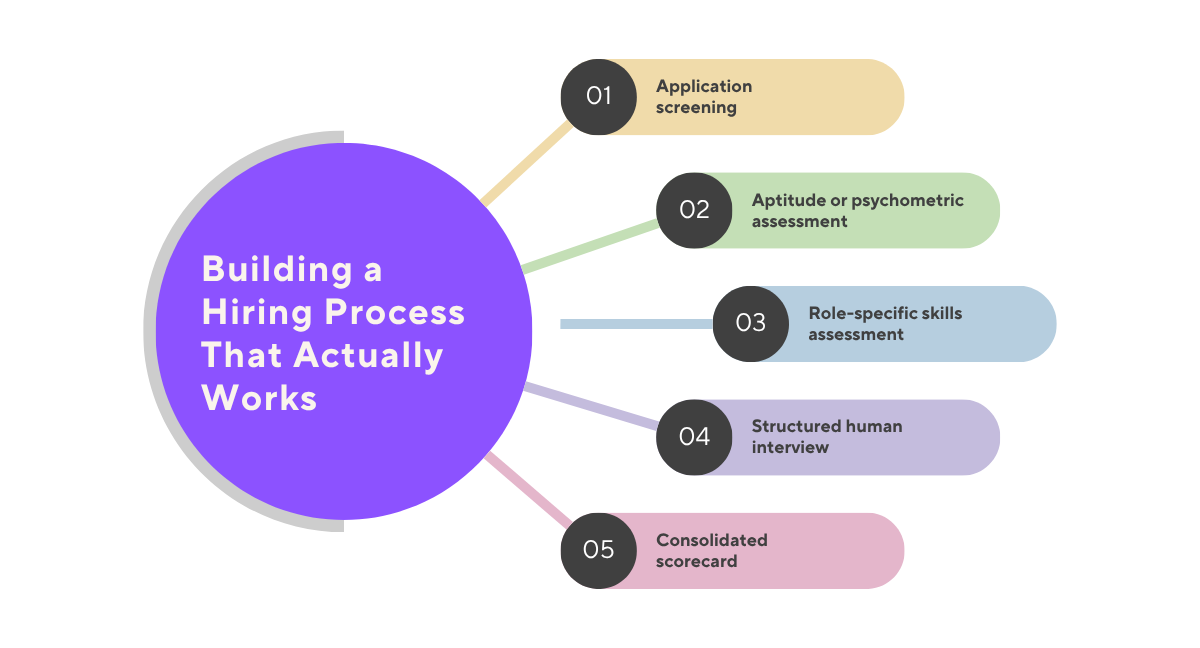
Building a Hiring Process That Actually Works
The shift from interview-first to assessment-first hiring isn't just about better tools - it's about building a process where every signal matters and every decision is grounded in evidence.
A high-performing hiring pipeline typically combines:
- Application screening - Filter on baseline criteria before any human time is spent
- Aptitude or psychometric assessment - Evaluate thinking style, personality, and cognitive ability early
- Role-specific skills assessment - Technical challenges, video interviews, or AI interviews depending on the role
- Structured human interview - Now informed by data, focused on confirming fit rather than fishing for signals
- Consolidated scorecard - A single view of every data point to support a confident final decision
CoderScout is built to support this entire pipeline - from application form to final scorecard - in one integrated platform.
Related Reads
If you found this post useful, check out these related articles:
- What Is a Skill-Based Hiring Platform? A Practical Guide for Modern Recruitment Teams
- AI Resume Screening to Skills Validation: Build a Better Hiring Pipeline
Frequently Asked Questions
Why can't interviews alone predict job performance?
Interviews are biased, reward preparation over ability, and measure communication confidence rather than job-relevant skills. Research shows unstructured interviews predict job performance with just 14% accuracy.
What is the most accurate way to predict job performance?
Combining structured assessments — work sample tests, cognitive ability tests, and personality assessments — is significantly more predictive than interviews alone. The highest accuracy comes from using multiple methods together.
What are psychometric tests and how do they help in hiring?
They are standardised assessments that measure personality, cognitive patterns, and behaviour. Tools like DISC and the OCEAN Big Five help hiring teams evaluate cultural fit and working style objectively, without bias.
How does AI improve the hiring and interview process?
AI brings consistency and scale. AI-powered interviews evaluate every candidate against the same criteria, remove interviewer bias, and generate structured reports with scores, summaries, and transcripts.
What is an AI-powered hiring platform?
It's a platform that uses artificial intelligence to automate and enhance stages of the hiring process — from resume screening and candidate assessment to interview scoring and performance evaluation. Think of it as a single integrated pipeline that replaces a dozen disconnected tools and spreadsheets.
How much does a bad hire cost a company?
Research estimates that a bad hire costs between 50% and 200% of that employee's annual salary — factoring in recruitment, onboarding, productivity loss, team disruption, and eventual rehiring costs.
Conclusion
Here's the thing — interviews aren't useless. They're just not the crystal ball we've pretended they are. A 45-minute conversation tells you something about how a candidate presents themselves, but it tells you very little about how they'll actually perform when the pressure is on, the deadline is tight, and nobody's watching.
The companies that hire the best talent aren't the ones with the sharpest interview questions. They're the ones that have built structured, data-driven pipelines that evaluate candidates across multiple dimensions — before anyone sets foot in an interview room.
CoderScout gives you the tools to build exactly that kind of pipeline. From psychometric tests and AI interviews to aptitude assessments and consolidated scorecards, every feature is designed to help you move from gut-feel hiring to evidence-based decisions — and build teams that actually perform.

Sources: Schmidt & Hunter (1998) — The Validity and Utility of Selection Methods in Personnel Psychology · SHRM — The Cost of Replacing an Employee (50%–200% of annual salary)