What Is a Skill-Based Hiring Platform? A Practical Guide for Modern Recruitment Teams

Hiring has changed. Candidates are no longer being evaluated only by where they studied, the companies they worked for, or the number of years written on a resume. Recruiters and hiring managers now need a clearer answer to a more important question: can this person actually do the work required for the role?
That is where a skill-based hiring platform becomes useful.
A skill-based hiring platform helps companies assess candidates through job-relevant tasks, structured assessments, objective scoring, and practical evaluation workflows. Instead of depending only on resumes and interviews, hiring teams can evaluate real ability across technical, analytical, communication, business, and role-specific skills.
For modern recruitment teams, this is not just a better way to screen candidates. It is a more consistent, fair, and scalable way to hire.
What Is a Skill-Based Hiring Platform?
A skill-based hiring platform is a recruitment solution that helps organizations evaluate candidates based on what they can do, not just what they claim on a resume.
It allows hiring teams to create assessments that match the skills required for a role. These assessments may include coding challenges, aptitude tests, multiple-choice questions, video responses, case studies, communication tasks, role-based simulations, or AI-assisted screening workflows.
The goal is simple: replace guesswork with evidence.
Instead of asking only, "Does this candidate look qualified?", a skill-based hiring platform helps teams ask better questions:
- Can the candidate solve real problems?
- Can they communicate clearly?
- Can they apply knowledge in a practical situation?
- Can they perform under realistic constraints?
- Can they meet the expectations of the role?
This approach gives recruiters and hiring managers a clearer view of candidate capability before moving people deeper into the hiring process.
Why Resume-First Hiring Falls Short
Resumes are useful, but they are incomplete.
A resume can show experience, qualifications, previous companies, tools used, and career progression. But it does not always show how a candidate thinks, solves problems, communicates, or performs in a role-specific situation.
This creates several challenges for hiring teams:
- Strong resumes do not always mean strong performance. Some candidates are good at presenting experience but struggle with practical tasks.
- Good candidates can be overlooked. Candidates from non-traditional backgrounds may have the skills but not the resume keywords.
- Interviews can be subjective. Different interviewers may evaluate the same answer differently.
- High-volume hiring becomes inconsistent. Manual screening is difficult when recruiters are managing hundreds or thousands of applications.
- Hiring teams lose time. Too many unqualified candidates reach later interview rounds because early screening is not evidence-based.
Skill-based hiring does not remove resumes from the process. It simply stops the resume from being the only filter.
How Skill-Based Hiring Works
A skill-based hiring process usually follows a structured flow.
First, the hiring team defines the skills that matter for the role. For example, a sales role may require communication, objection handling, product understanding, and decision-making. A customer support role may require written communication, empathy, problem-solving, and process knowledge. A developer role may require coding ability, debugging, SQL, system thinking, or familiarity with a specific language.
Next, the team creates assessments that measure those skills. The assessment should be relevant to the work the candidate will actually do. This is important because a generic test may produce a score, but a role-relevant task produces useful hiring signal.
Then, candidates complete the assessment in a structured environment. The platform collects responses, scores performance, tracks completion, and provides reports that help hiring teams compare candidates more objectively.
Finally, recruiters and hiring managers use assessment results alongside interviews, experience, and team fit to make better decisions.
The best skill-based hiring process does not replace human judgment. It gives hiring teams better information before they use that judgment.
What Skills Can a Skill-Based Hiring Platform Assess?
A strong skill-based hiring platform should support more than one type of role. It should help teams evaluate a wide range of capabilities across technical and non-technical hiring.
Technical Skills
Technical assessments are useful for roles such as software developers, data analysts, QA engineers, database professionals, and technical support teams.
Examples include:
- Programming challenges
- SQL assessments
- Debugging tasks
- Data analysis questions
- Technical MCQs
- Real-world problem-solving exercises
For technical roles, practical assessments are especially valuable because resumes rarely show how someone writes code, structures logic, handles edge cases, or approaches a problem.
Cognitive and Analytical Skills
Many roles require strong reasoning ability, even when they are not technical.
Examples include:
- Logical reasoning
- Numerical ability
- Problem-solving
- Pattern recognition
- Business judgment
- Data interpretation
These skills are useful for analyst roles, operations teams, management trainees, campus hiring, and entry-level recruitment.
Communication Skills
Communication is one of the most important hiring signals across almost every department.
Examples include:
- Written responses
- Video responses
- Email drafting tasks
- Customer scenario responses
- Presentation-style answers
- Listening and comprehension checks
This is useful for customer success, sales, support, marketing, operations, HR, and leadership-track roles.
Role-Specific Skills
Some of the best hiring assessments are built around real situations from the role.
Examples include:
- A customer support candidate responding to an upset customer.
- A sales candidate handling a pricing objection.
- An operations candidate prioritizing tasks during a process delay.
- A marketing candidate reviewing campaign performance.
- A recruiter evaluating candidate profiles against a job description.
- A developer solving a real coding problem in a browser-based environment.
These assessments are more practical than generic interview questions because they show how the candidate may perform on the job.
Traditional Hiring vs Skill-Based Hiring
Traditional hiring often starts with background. Skill-based hiring starts with ability.
| Traditional Hiring | Skill-Based Hiring |
|---|---|
| Filters candidates mainly through resumes | Evaluates candidates through role-relevant tasks |
| Relies heavily on past titles and credentials | Measures practical capability |
| Can be subjective and inconsistent | Uses structured scoring and comparison |
| Often moves weak-fit candidates into interviews | Helps shortlist stronger candidates earlier |
| Depends on manual screening | Supports automation and data-backed decisions |
This does not mean experience and interviews are no longer important. They still matter. But skill-based hiring gives teams a stronger foundation before they spend time on deeper conversations.
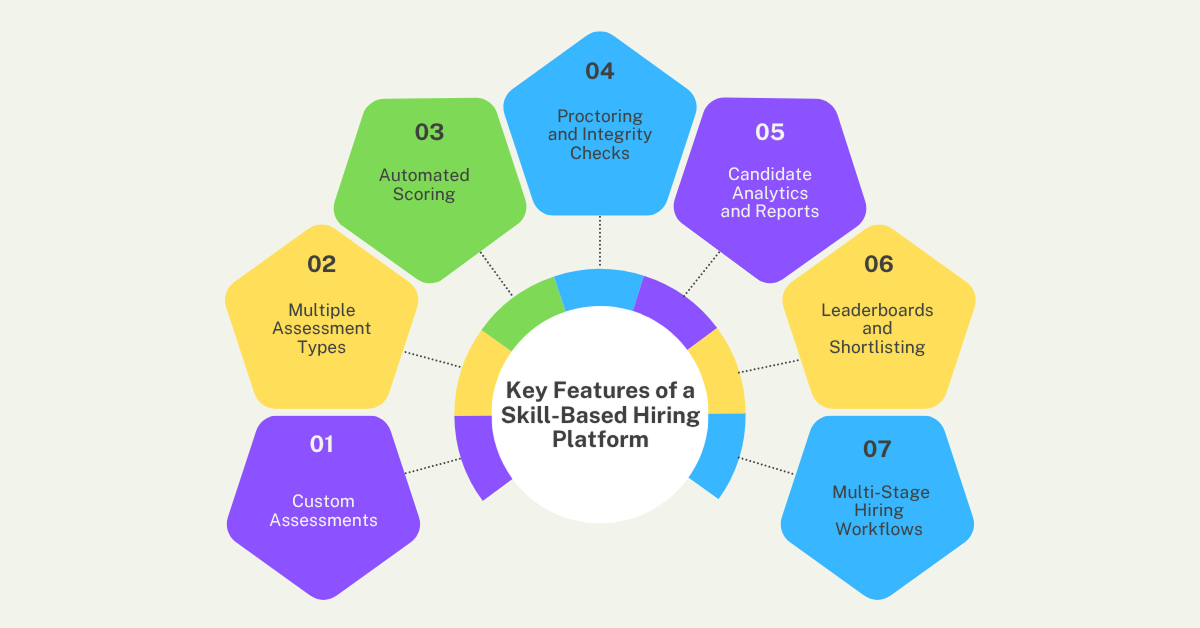
Key Features of a Skill-Based Hiring Platform
When evaluating a skill-based hiring platform, recruitment teams should look for features that improve both assessment quality and hiring efficiency.
1. Custom Assessments
Every role is different. A good platform should allow hiring teams to create assessments based on the actual skills required for the job.
Custom assessments help teams avoid generic screening and make the evaluation more relevant to the role.
2. Multiple Assessment Types
A single hiring process may need more than one type of evaluation.
Useful assessment formats include:
- MCQs
- Aptitude tests
- Coding challenges
- SQL tasks
- Video responses
- Written answers
- Case-study questions
- Role-based simulations
- AI-assisted screening
The more flexible the platform, the easier it is to design a complete hiring workflow.
3. Automated Scoring
Manual review can slow down hiring, especially when application volume is high.
Automated scoring helps teams evaluate candidates faster and more consistently. It also gives recruiters a clearer way to compare candidates before involving hiring managers.
4. Proctoring and Integrity Checks
Remote hiring makes assessment integrity important.
Features such as webcam monitoring, screen monitoring, plagiarism detection, similarity checks, and suspicious activity flags help maintain fairness during the assessment process.
5. Candidate Analytics and Reports
Recruiters need more than pass or fail results. They need useful insights.
A good platform should provide reports that show candidate scores, strengths, weaknesses, completion status, time taken, and performance across different skill areas.
6. Leaderboards and Shortlisting
When hiring at scale, teams need a quick way to identify top performers.
Leaderboards help recruiters compare candidates based on structured performance data. This is especially useful for campus hiring, walk-in drives, internships, and high-volume recruitment.
7. Multi-Stage Hiring Workflows
Modern hiring rarely happens in one step.
A skill-based hiring platform should support multiple stages, such as application screening, aptitude tests, role-specific assessments, video responses, AI technical interviews, and final review. This helps teams manage the full journey in a structured way.
Benefits of Skill-Based Hiring for Recruiters
Skill-based hiring makes recruitment more practical and measurable.
For recruiters, the biggest benefits include:
- Faster screening: Candidates can be evaluated before long interview rounds.
- Better shortlisting: Recruiters can move forward with candidates who have shown real ability.
- Less bias: Structured assessments reduce dependency on assumptions from resumes.
- Improved consistency: Every candidate can be evaluated against the same criteria.
- Reduced manual effort: Automated scoring and reports save time.
- Better hiring manager alignment: Assessment results make candidate discussions more objective.
- Scalable hiring: Teams can manage large applicant pools without losing evaluation quality.
This is especially valuable when hiring across departments, locations, campuses, or large candidate pipelines.
Benefits for Candidates
Skill-based hiring is not only better for companies. It can also create a better candidate experience.
Candidates get a chance to prove their ability, even if their resume is not perfect. This matters for freshers, career switchers, self-taught professionals, and candidates from non-traditional backgrounds.
A structured assessment also makes expectations clearer. Candidates understand what they are being evaluated on, and hiring teams get more consistent data from the process.
When designed well, skill-based hiring feels fairer because candidates are judged on relevant work, not only on labels from their past.
Where Skill-Based Hiring Works Best
Skill-based hiring can be used across many hiring scenarios.
It is especially useful for:
- Campus hiring
- Walk-in drives
- High-volume recruitment
- Entry-level roles
- Lateral hiring
- Internships
- Customer support hiring
- Sales hiring
- Operations hiring
- Analyst hiring
- Developer hiring
- Technical support hiring
- Remote hiring
The common factor across all these scenarios is the need for structured, scalable, and practical candidate evaluation.
How CoderScout Supports Skill-Based Hiring
CoderScout helps recruitment teams build structured assessment workflows for both technical and non-technical roles.
Teams can use CoderScout's multi-stage assessment workflows to combine role-relevant evaluations such as coding challenges, MCQs, aptitude assessments, application-based stages, video responses, AI screening, proctoring, leaderboards, and detailed reports in one structured hiring flow.
For technical roles, CoderScout supports hands-on coding assessments, SQL tasks, code playback, automated evaluation, and performance insights. For non-technical roles, teams can design assessments around communication skills, aptitude, reasoning, business scenarios, role-specific questions, psychometric testing, and structured screening workflows.
This makes CoderScout useful for organizations that want one platform to evaluate candidates more consistently across multiple hiring needs.
Instead of relying only on resumes or disconnected tools, recruitment teams can use CoderScout to run a more evidence-based hiring process from screening to shortlisting.
How to Choose the Right Skill-Based Hiring Platform
Before selecting a platform, hiring teams should ask practical questions:
- Can it support both technical and non-technical assessments?
- Can we customize assessments for different roles?
- Does it support high-volume hiring?
- Does it provide automated scoring and useful reports?
- Can it help reduce cheating or plagiarism?
- Is the candidate experience simple and clear?
- Can recruiters and hiring managers collaborate easily?
- Does it support multi-stage hiring workflows?
The right platform should not only test candidates. It should help the entire hiring team make better decisions with less manual effort.
Final Thoughts
Hiring teams are under pressure to move faster, improve quality, reduce bias, and create a better candidate experience. Resume-first hiring alone cannot solve all of these problems.
A skill-based hiring platform gives recruitment teams a more practical way to evaluate candidates. It helps companies understand what candidates can actually do, compare them more fairly, and make decisions based on evidence rather than assumptions.
For modern recruitment teams, skill-based hiring is not just a trend. It is becoming a better operating model for hiring across technical and non-technical roles.
If your team wants to screen candidates more objectively, reduce manual effort, and build a more structured hiring process, CoderScout can help you create skill-based assessments that fit the roles you are hiring for.