AI Resume Screening to Skills Validation: Build a Better Hiring Pipeline

Hiring teams think they have a resume problem.
Too many applications. Too little time. Not enough recruiters.
The usual response is to make resume screening faster: a better ATS, better filters, better AI.
Those tools help. But they don't fix the real issue.
The problem isn't reviewing resumes. The problem is treating resumes as the primary hiring signal.
A resume tells you where someone worked, what technologies they mention, and what they claim to have done. It doesn't tell you whether they can actually do the job.
That's why a growing number of hiring teams, across both technical and non-technical functions, are rethinking where resumes belong in the evaluation process. Not removing them. Repositioning them.
The Resume Was Never Designed to Predict Performance
For decades, hiring has started with the same question: who looks most qualified on paper?
That worked reasonably well when application volumes were lower and hiring moved slower. Today, a single job posting receives an average of 257.6 applications (Employ Inc., 2026 Hiring Benchmarks Report), and no recruiting team has time to investigate every profile in depth. Resumes become a shortcut. Candidates get judged on previous employers, degrees, certifications, job titles, and years of experience.
Those signals can be useful. But they're still signals. None of them directly measure capability.
A candidate can have an impressive resume and weak skills. Another can have a modest resume and exceptional skills. Traditional pipelines consistently favor the former, not because recruiters are careless, but because the resume-first model was never built to surface the second candidate. In fact, a Harvard Business School study found that 88% of employers believe their own hiring systems filter out qualified high-skills candidates simply because they don't match the exact criteria spelled out in the job description, even when those candidates could likely perform the job successfully.
Why AI Resume Screening Alone Isn't Enough
Here's the uncomfortable part: most hiring teams believe their problem is reviewing resumes too slowly. It isn't. The real problem isn't resume screening itself. It's treating resume screening as the final hiring decision rather than the first one.
AI resume screening can rank, score, and prioritize candidates in seconds instead of hours. That's a genuine improvement in operational efficiency, and the market reflects it: just over half of organizations (51%) now use AI to support recruiting, with resume screening among the most common applications, according to SHRM's 2025 Talent Trends data.
That doesn't make resume screening less valuable. If anything, modern hiring teams need it more than ever, because application volume keeps growing and someone still has to decide who's worth a closer look. The mistake isn't using resume screening. The mistake is expecting resume screening to identify the best hire on its own.
But speed doesn't fix weak signals. If resumes are a poor predictor of on-the-job performance, screening them faster just means you arrive at a weak decision sooner.
Resume ≠ ability. That single distinction is the difference between automating your hiring process and actually improving it.
Where AI Resume Screening Earns Its Place
AI resume screening is one of the most widely adopted recruiting technologies for a reason: it solves a real, painful problem. Instead of manually reading hundreds of resumes, recruiters can rank applicants automatically, apply evaluation criteria consistently, and cut administrative workload dramatically.
For high-volume hiring, that's a meaningful advantage. CoderScout's AI resume screening, for example, is built to screen 100+ resumes in minutes by evaluating skill match, experience alignment, and role context rather than relying on keyword filters alone.
The distinction that matters: AI improves the speed of resume evaluation. On its own, that doesn't determine whether the candidates it surfaces are the right ones. That depends on what happens after screening, not instead of it.
This is why the organizations that get the best hiring outcomes don't skip resume screening. They lean on it harder, then build the rest of the pipeline (assessments, structured evaluation, interviews) on top of it.
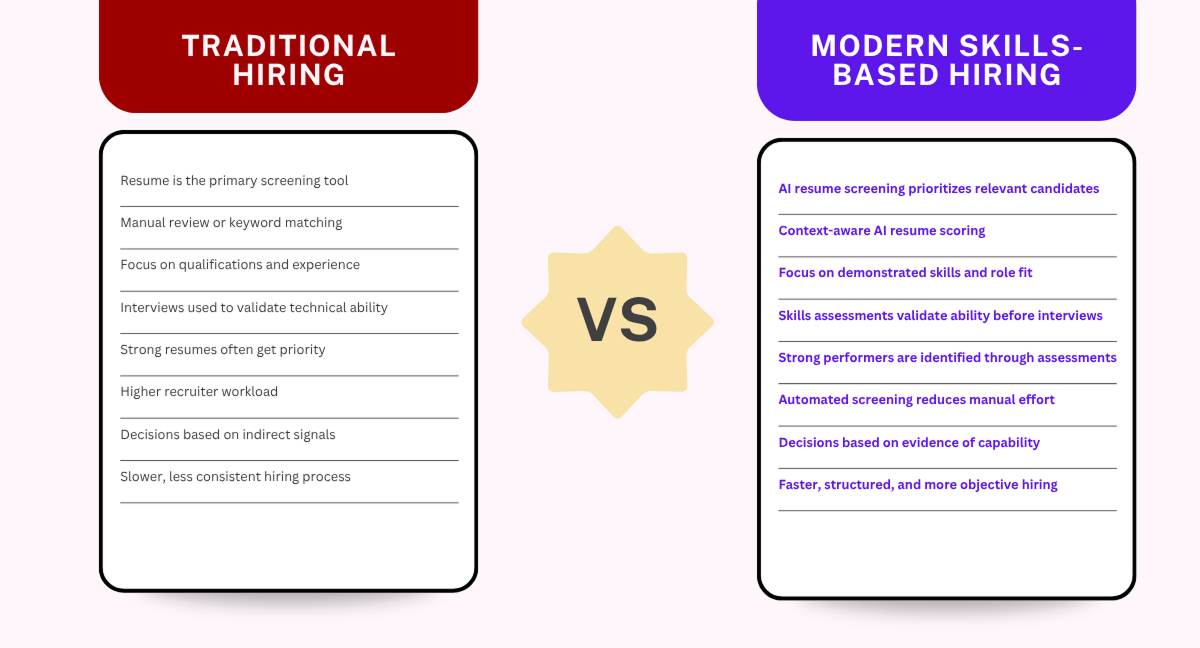
AI Resume Screening vs. ATS Keyword Matching
These two are often confused, but they solve different problems.
| Boolean / ATS Keyword Matching | AI Resume Screening (Context-Aware) | |
|---|---|---|
| How it decides | Searches for exact keyword matches | Evaluates skills, experience, and role context |
| Handles synonyms/variants | Rarely (e.g., misses "JS" for "JavaScript") | Yes, understands related terms and context |
| Risk of false negatives | High, strong candidates get filtered for phrasing | Lower, profiles are evaluated holistically |
| Output | Pass/fail keyword match | Structured score and ranked shortlist |
| Scales with volume | Yes, but with declining accuracy | Yes, with consistent evaluation criteria |
| Predicts job performance | Weak, same limitation as manual resume reading | Better, but still resume-bound unless paired with skills validation |
Notice the last row. Even the best AI resume screening is still working from a resume. That's exactly why it's most powerful when it's the first stage of a pipeline, not the only one.
The Shift Toward Skills-Based Hiring
Skills-based hiring starts with a different question. Instead of "who looks qualified?" it asks "who can demonstrate the skills required for success?"
Rather than relying heavily on resumes, organizations build evidence of ability into the pipeline itself: coding assessments, technical challenges, role simulations, aptitude testing, and communication exercises.
The momentum is significant: according to SHRM, 73% of employers now use some form of skills-based hiring, and LinkedIn's 2025 Workforce Report found that job postings emphasizing skills over degree requirements are accelerating year-over-year.
This is gaining traction across both technical and non-technical hiring:
- Software engineers and data professionals can complete real programming challenges, SQL and data engineering tasks, REST API challenges, or work through problems inside a notebook environment.
- Functional and customer-facing candidates, such as sales, support, and operations, can be evaluated through communication skills assessments, aptitude testing, and structured English fluency assessment where it's role-relevant.
- Any role, technical or not, can be paired with psychometric assessment to evaluate behavioral fit alongside hard skills.
The principle holds across all of them: evaluate what candidates can do, not just what they claim.
A Quick Example: Hiring for 500 Applications, One Role
Say a company posts a single opening for a backend developer and receives 500 applications in the first week, not unusual for a remote-friendly engineering role.
In a resume-first pipeline, a recruiter might spend 30 seconds to a few minutes per resume. At scale, that's several hours of manual reading before a single candidate has proven they can write a line of working code. Strong keyword matches advance. Self-taught engineers without the "right" resume language often don't, regardless of ability.
In a skills-first pipeline, the same 500 applicants are first ranked using CoderScout's AI resume scoring against the role's actual requirements: skill match, experience relevance, role context. The top tier, say 60–80 candidates, are automatically invited to a short programming challenge. Only candidates who pass that bar reach a recruiter or hiring manager's calendar.
The recruiter still reviews 500 applications. They just don't manually read all 500. The candidates who reach an interview have already demonstrated, not claimed, the skill the role needs.
The Hidden Costs of Resume-First Hiring
Strong candidates get missed
Self-taught professionals, career changers, returning professionals, and candidates from smaller organizations often have real skills that don't map cleanly onto resume conventions. Semantic AI screening helps, but without skills validation, these candidates still fall through.
Weak candidates advance too far
A polished resume can create confidence that isn't backed by capability. Without skill validation, interview time gets spent discovering problems that could have surfaced much earlier.
Hiring decisions become less consistent
Different recruiters weigh different signals. Without structured evaluation criteria, decision-making becomes subjective and harder to defend or audit later.
Time gets invested in the wrong candidates
Interviews are expensive. The later a weak candidate is filtered out, the more organizational time (recruiter hours, hiring manager hours, SME hours) has already been spent on them. According to LinkedIn's Future of Recruiting report, 61% of Talent Acquisition (TA) professionals believe AI can improve quality of hire, highlighting a growing shift from using AI solely for efficiency to leveraging it for better hiring outcomes.
What Modern Hiring Teams Are Doing Differently
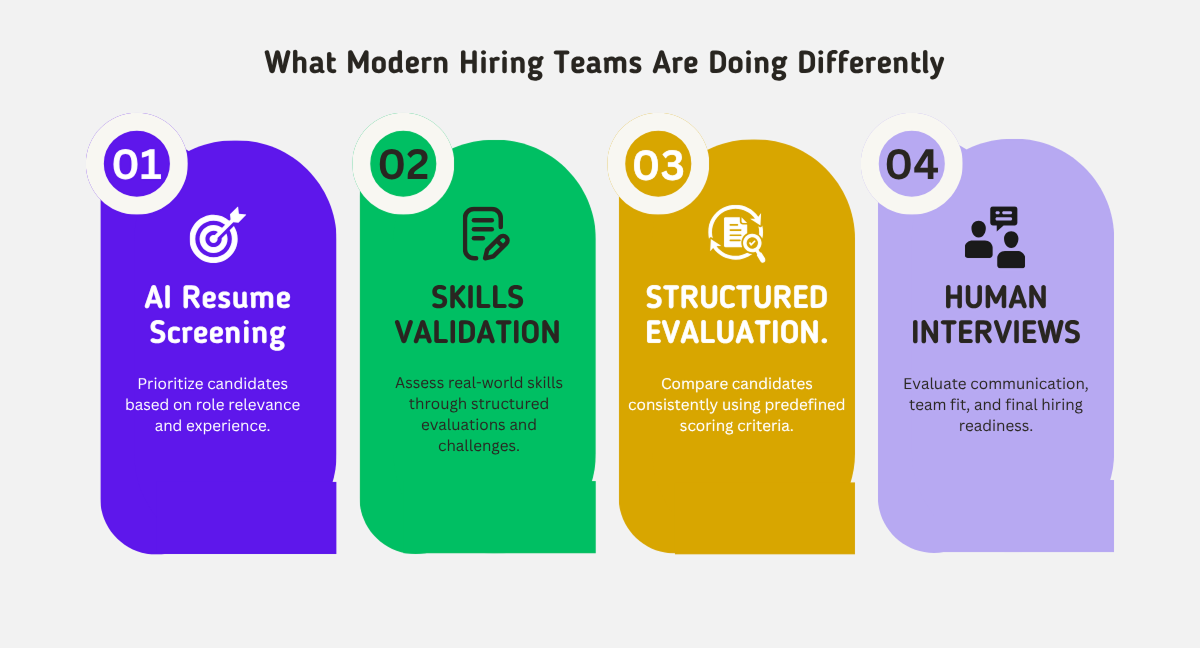
Leading organizations are moving toward a layered evaluation model. Each stage answers a different question.
Stage 1: AI Resume Screening. Does this candidate appear relevant to the role? CoderScout's automated, role-based resume screening helps recruiters prioritize applicants and cut manual review effort, often by 70%+ depending on volume.
Stage 2: Skills Validation. Can this candidate demonstrate the required skills? This is where structured, multi-stage assessments, including coding tests, quizzes, AI interviews, and video responses, replace assumption with evidence.
Stage 3: Structured Evaluation. How does this candidate compare against predefined hiring criteria? Evaluation templates and scoring frameworks make this stage consistent and measurable rather than dependent on whoever happens to be reviewing the file.
Stage 4: Human Interviews. Will this person succeed within our team and environment? Human judgment is still essential. It's just applied later, once there's already evidence of capability. CoderScout's platform is built so that human interviews happen last, only after candidates have proven relevant fit.
Why AI Works Best When Combined With Human Judgment
There's often debate about whether AI should replace human decision-making in hiring. The better question is: where does AI create the most value?
The answer is usually at the top of the funnel. AI excels at processing volume, identifying patterns, ranking candidates, and applying criteria consistently. Humans excel at understanding context, evaluating communication nuance, assessing team fit, and making the final call.
Skills assessments bridge the two. Teams using structured, AI-supported hiring workflows see 24–30% higher assessment consistency compared to unstructured interviews (Second Talent, 2025). Together, AI resume screening, structured assessments, and human interviews create a hiring process that is faster, more scalable, more objective, and, most importantly, more predictive of actual job performance.
Built for Both Tech and Non-Tech Hiring
Skills-first hiring isn't a technical-hiring-only idea, even though coding assessments get most of the attention. The same logic applies to non-technical hiring: a sales candidate can be evaluated against realistic scenarios, a support candidate against simulated customer conversations, and any functional role against domain-specific quizzes, psychometric profiles, and structured interviews.
For technical hiring, the same workflow extends to engineers, data professionals, and AI/ML roles through AI-powered technical interviews layered on top of coding and SQL assessments.
Whether the open role is a backend engineer or a regional sales manager, the operating model doesn't change: screen for relevance with AI resume screening, validate skills, evaluate consistently, interview last.
Frequently Asked Questions
What is AI resume screening? AI resume screening uses machine learning and natural language processing to evaluate, score, and rank resumes against predefined role requirements, going beyond exact keyword matches to assess skill relevance and experience alignment.
Is AI resume screening better than ATS keyword matching? Generally, yes for accuracy. Modern AI screening evaluates context and role relevance rather than relying solely on exact keyword hits, which reduces the number of qualified candidates filtered out for phrasing reasons alone.
Can AI resume screening reduce hiring bias? It can improve consistency by applying the same evaluation criteria to every candidate. But outcomes still depend on how those criteria are defined. Poorly designed criteria can still produce biased results, so the evaluation logic itself matters.
Can AI resume screening reject qualified candidates? Yes, if the criteria are too narrow or the role requirements are poorly defined. This is one reason resume screening works best as a prioritization step feeding into skills validation, rather than as the sole gatekeeper to an interview.
Should AI resume screening replace skills assessments? No. Resume screening helps prioritize candidates from a large pool; assessments validate their actual capability. The strongest pipelines combine both rather than treating either as sufficient on its own.
What's the difference between resume screening and resume scoring? Resume screening identifies relevant candidates from an applicant pool. Resume scoring goes a step further, assigning a structured rating based on how closely a candidate matches specific role requirements: skill match, experience relevance, and role context.
Is skills-based hiring only useful for technical roles? No. It applies just as well to operational, customer-facing, sales, and leadership roles through role-specific assessments and simulations, not just coding tests.
How accurate is AI resume screening? Accuracy depends heavily on how role requirements are configured and how much context the system uses beyond keywords. Screening tools that evaluate skill match and experience relevance, like CoderScout's AI resume screening, tend to surface stronger candidate pools than simple keyword filters because they're less likely to miss qualified candidates over phrasing alone.
Build a More Effective Hiring Pipeline
Hiring teams don't need to choose between speed and quality.
The most effective organizations combine AI resume screening with structured skills evaluation to identify strong candidates earlier and make hiring decisions with more confidence.
With CoderScout, teams can:
- Screen and score resumes with AI against real role requirements, not just keywords
- Run technical and non-technical skills assessments at scale
- Conduct AI-assisted technical interviews
- Evaluate every candidate against the same structured criteria
- Manage the entire workflow (screening, assessment, interviews) from one platform, for both tech and non-tech roles
AI resume screening helps you find promising candidates. Skills validation helps you find the right ones
Sources
- Employ Inc., 2026 Hiring Benchmarks Report (257.6 average applications per job); PDF
- Harvard Business School, Hidden Workers: Untapped Talent (88% of employers filter out qualified candidates)
- SHRM, 2025 Talent Trends: AI in HR (44% of organizations use AI to screen resumes); additional coverage
- SHRM, Skills-Based Hiring (73% of employers adopted skills-based hiring)
- LinkedIn, Future of Recruiting 2025 (61% of Talent Acquisition professionals believe AI can improve quality of hire)