How to Run Frictionless Campus Recruitment Drives: A Playbook for Educational Institutes and Employers

Campus recruitment should be efficient, fair, and easy to manage. In practice, it often becomes the opposite.
Placement officers end up coordinating multiple rounds, employers struggle to compare large batches of submissions, candidates wait too long for feedback, and manual review creates bottlenecks that slow the entire drive. When dozens or hundreds of students are involved, even a well-planned campus hiring process can become difficult to execute cleanly.
The answer is not to reduce the quality bar. The answer is to structure the drive so evaluation happens faster, with more consistency and less manual effort.
A frictionless campus recruitment drive gives university teams and employers a way to assess hundreds of candidates simultaneously, detect cheating risks early, score submissions automatically, and rank candidates instantly. That makes the process more scalable without making it less rigorous.
For teams searching for a campus recruitment drive platform that can handle volume without sacrificing fairness, the right workflow matters as much as the assessment itself.
Why Campus Recruitment Gets Stuck
Campus hiring looks simple on paper. Recruit students, run assessments, shortlist the best performers, and move forward.
The reality is more complicated.
Here are the common friction points:
- Too many candidates submit at the same time.
- Different assessors apply different standards.
- Manual scoring slows down shortlisting.
- Cheating risks increase when drives happen remotely or at scale.
- Placement teams have to coordinate between faculty, employers, and candidates.
- Recruiters need results quickly, but reporting takes too long.
When these issues stack up, the process becomes stressful for everyone involved.
Educational institutes want a fair evaluation process for their students. Employers want quality candidates without spending days reviewing submissions. Candidates want a professional, transparent experience that gives them confidence in the outcome.
That is why the campus recruitment workflow needs to be built around scale and integrity from the start.
What A Frictionless Drive Looks Like
A frictionless campus recruitment drive is not one with fewer stages by default. It is one where each stage is designed to be easy to run, easy to monitor, and easy to evaluate.
The best drives usually share four traits:
- The process is clear before students start.
- The assessment format matches the role.
- The scoring is automated or semi-automated.
- The final ranking is available immediately after completion.
For university placement officers, this means less manual coordination and less back-and-forth with employers.
For enterprise HR leads and early talent recruiters, it means better throughput, cleaner evaluation, and faster decisions.
Build The Drive Around The Right Assessment Flow
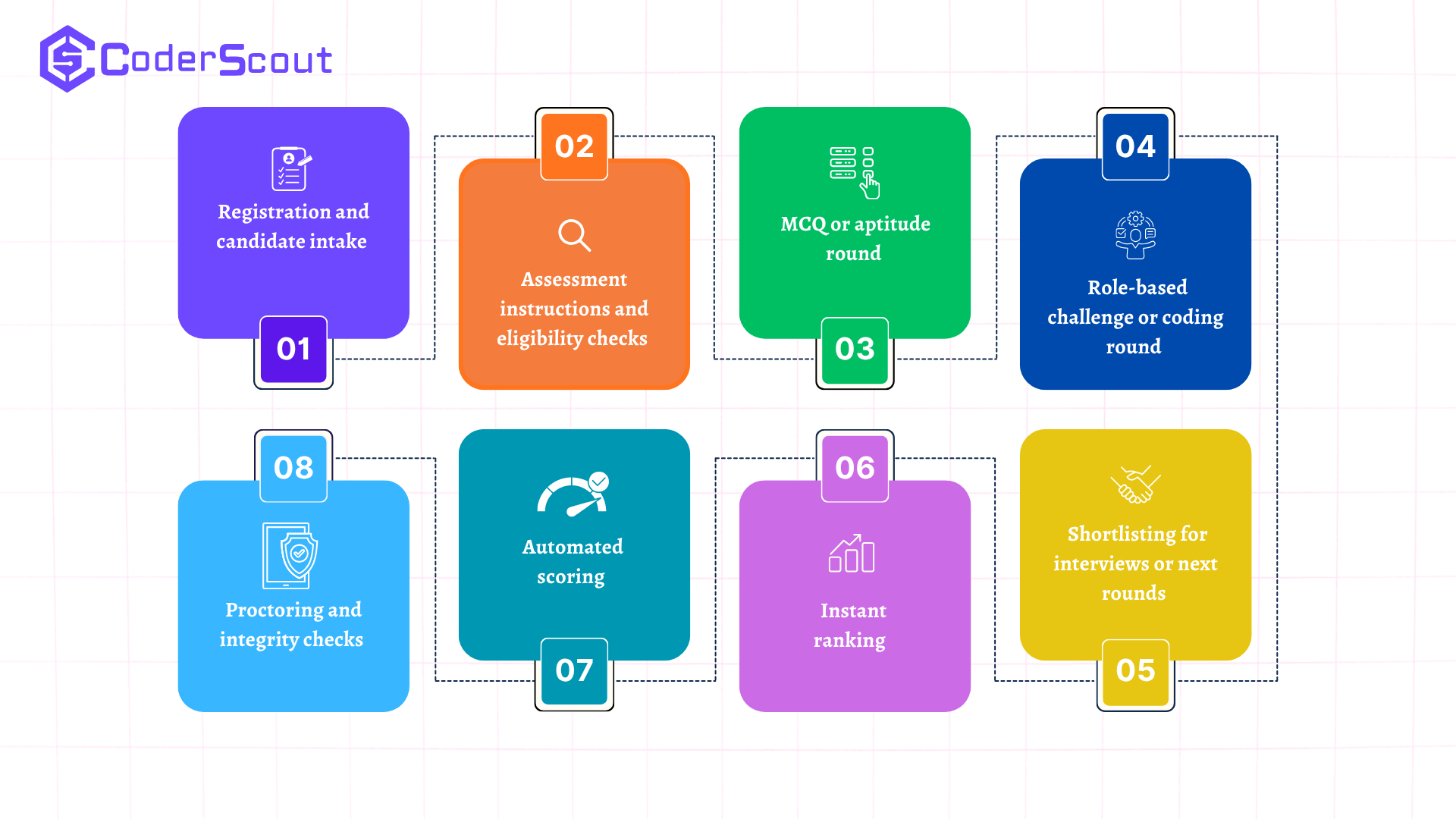
The easiest way to reduce friction is to use a structured flow that mirrors the hiring intent.
A practical campus drive can follow this sequence:
- Registration and candidate intake
- Assessment instructions and eligibility checks
- MCQ or aptitude round
- Role-based challenge or coding round
- Proctoring and integrity checks
- Automated scoring
- Instant ranking
- Shortlisting for interviews or next rounds
This structure works because it separates the administrative part from the evaluation part.
Candidates know what to expect. Recruiters know how results will be generated. Placement teams know how to move from one round to the next without creating delays.
Use Anti-Cheating Controls Early
Campus drives can lose credibility quickly if the process does not protect assessment integrity.
That is why anti-cheating controls should be part of the workflow, not an afterthought.
Useful controls include:
- Webcam monitoring
- Screen monitoring
- Auxiliary device monitoring
- Suspicious activity detection
- Tab-switching alerts
- Audio and noise monitoring
- Plagiarism detection
- Trust or integrity scoring
When these signals are captured during the assessment, recruiters can review submissions with much more confidence.
For large campus drives, this matters because the goal is not only to filter candidates quickly. It is to ensure the shortlist is trustworthy.
Evaluate Hundreds Of Submissions At Once
The real challenge in campus hiring is not finding candidates. It is evaluating them efficiently.
A modern assessment platform should let you handle large batches without asking a human reviewer to inspect every submission from scratch.
That is where automated scoring becomes valuable.
Instead of manually checking each answer, the platform can evaluate responses using test cases, correct-answer logic, scoring rubrics, or AI-based analysis depending on the question type. This allows placement teams and employers to process high volumes without losing consistency.
For technical assessments, automated scoring can check output accuracy, edge cases, and solution quality.
For non-technical assessments, scoring can evaluate aptitude, communication, reasoning, and role-fit indicators.
The outcome is the same: less time spent on manual review and more time spent on meaningful shortlisting.
Use Instant Ranking To Shortlist Faster
Once the submissions are scored, the next bottleneck is comparison.
If your team is reviewing hundreds of responses, it becomes hard to spot the strongest candidates quickly unless the platform provides a clear ranking view.
Instant ranking solves this problem by organizing candidates based on performance data immediately after the assessment closes.
This helps in several ways:
- Recruiters can identify the top performers in minutes.
- Placement officers can present cleaner shortlists to employers.
- Employers can compare students using the same standard.
- Candidates experience a more transparent process because decisions appear evidence-based.
When ranking is tied to scoring, completion time, and integrity checks, the shortlist becomes more defensible.
What Educational Institutes Should Prioritize
For universities and placement offices, the biggest priority is fairness at scale.
That means the platform should support:
- Large candidate batches
- Easy candidate invitations
- Clear instructions for students
- Secure assessment sessions
- Objective scoring
- Fast report generation
- Bulk ranking and export
It should also be simple enough for coordinators to use without needing to manage complex setup steps every time a new company arrives on campus.
If the process is too manual, the institution ends up spending more time on logistics than on outcomes.
What Employers Should Prioritize
Employers running campus recruitment drives usually care about speed, consistency, and shortlist quality.
They need a system that helps them:
- Run the same process across multiple campuses
- Compare candidates fairly
- Reduce review time
- Avoid compromised submissions
- Move strong candidates into interviews faster
For enterprise HR leads, this is especially important when the drive is connected to internships, graduate hiring, or bulk early-talent recruitment.
The platform should make it easy to move from assessment to decision without adding unnecessary coordination overhead.
How CoderScout Supports Campus Recruitment
CoderScout is built to help educational institutes and employers run campus recruitment drives with less friction and more confidence. It helps teams move from registration to shortlist without stitching together separate tools for assessment, proctoring, scoring, and ranking.
For high-volume drives, CoderScout's campus hiring feature enables teams to run structured drives that include MCQs, coding challenges, AI interviews, live interviews, proctoring, and scoring in one flow.
To maintain integrity, CoderScout includes AI proctoring, screen monitoring, and auxiliary device proctoring so organizers can detect suspicious behavior and review trust signals before final decisions are made.
For comparison and shortlisting, CoderScout provides candidate leaderboards and automated scoring so recruiters can rank candidates instantly instead of reviewing every submission manually.
That combination is what makes campus recruitment feel frictionless: fewer disconnected steps, faster evaluation, and a clearer shortlist at the end.
A Practical Playbook For Your Next Drive
If you are planning a campus recruitment drive, use this checklist:
- Define the role and required skills before the drive starts.
- Decide which assessment stages are truly necessary.
- Use a platform that supports bulk invitations and structured evaluation.
- Enable proctoring and integrity checks for remote or high-stakes drives.
- Automate scoring wherever possible.
- Use ranking to identify the strongest candidates immediately.
- Share outcomes quickly so candidates and employers are not left waiting.
The more repeatable your process becomes, the easier it is to scale across campuses and hiring seasons.
Final Thoughts
Frictionless campus hiring is not about lowering standards. It is about removing unnecessary friction from a process that already involves large candidate volumes and multiple stakeholders.
When educational institutes and employers use structured assessments, anti-cheating controls, automated scoring, and instant ranking, they create a drive that is faster, fairer, and easier to manage.
That is the model modern campus recruitment needs.
If your team wants to run better campus drives at scale, CoderScout can help you build the workflow.