Beyond LeetCode: Why Real-World Problem Solving Beats Algorithm Trivia in Tech Hiring

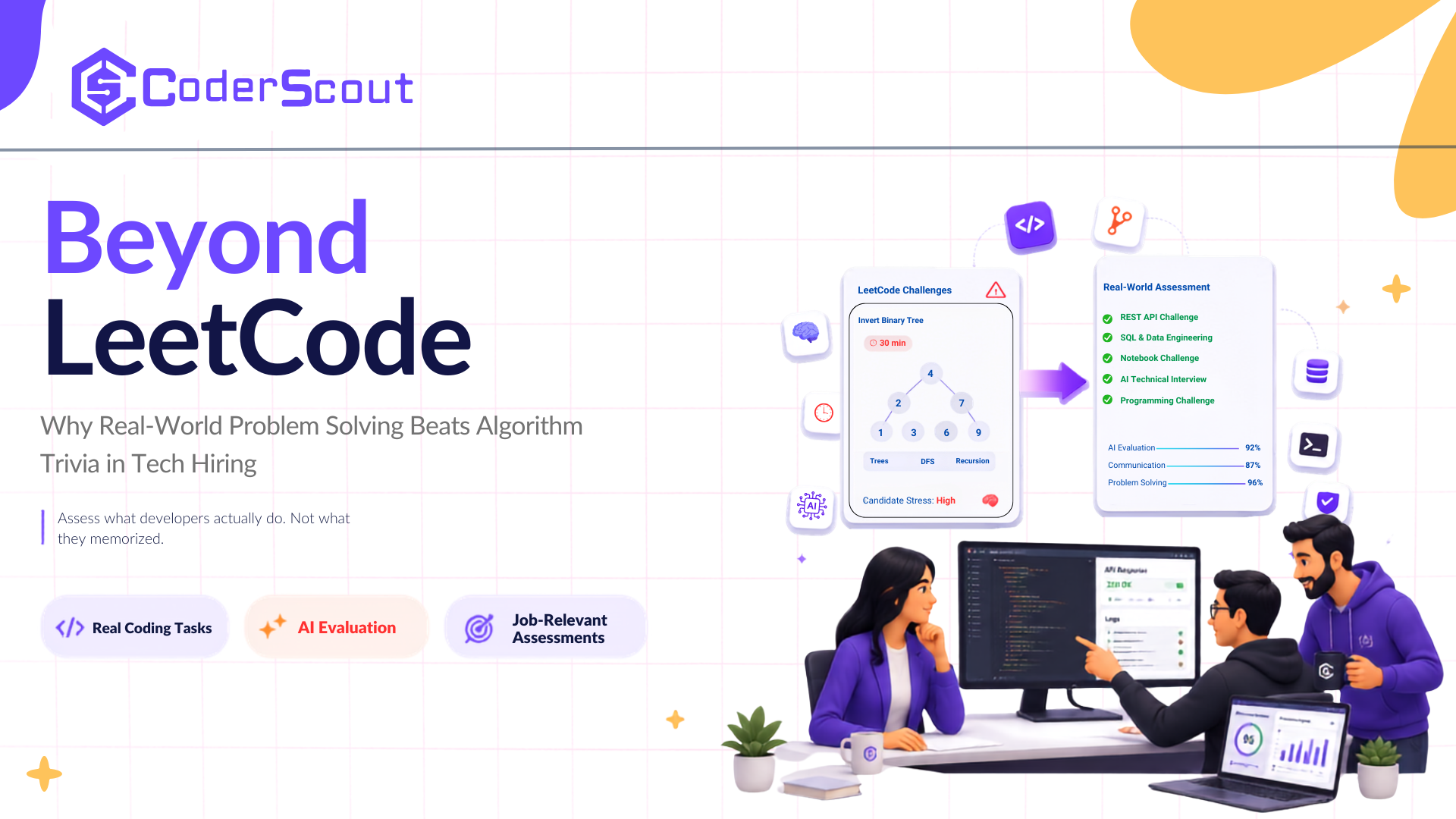
Most developers will go their entire career without needing to invert a binary tree on demand.
And yet, for 15 years, that's roughly what tech hiring has asked them to do: sit in front of a whiteboard or a shared code editor, under time pressure, with no internet access and no teammate, and solve a puzzle they'll likely never encounter again once they have the job.
The skill being tested (recalling an obscure algorithm under stress) is almost the opposite of what the job actually requires: solving ambiguous, often messy problems with the help of documentation, teammates, and time to think.
The gap between interview performance and job performance isn't a minor calibration issue. It's a structural one. In 2026, a growing number of companies are rebuilding their hiring pipelines around a different question. Not "can you solve this puzzle," but "can you do this job."
The Problem With Algorithm-Only Hiring
For most of the last two decades, the algorithm interview has functioned as the default gatekeeper into software engineering. It's efficient to administer, easy to compare across candidates, and it feels objective. There's a right answer, and you either found it or you didn't.
That objectivity is largely an illusion, though. What it actually measures is a narrow, specific skill: performing under artificial pressure in an environment stripped of every tool a developer would normally use. It doesn't measure whether someone can read an unfamiliar codebase, communicate a tradeoff to a product manager, or debug a production issue at 2 a.m. with a Slack channel full of people waiting on an answer.
The cost of getting that calibration wrong isn't abstract. Turing's research on hiring costs puts the cost of a bad hire at up to 30% of that employee's first-year salary once you factor in lost productivity, onboarding investment, team disruption, and the cost of re-running the search. A widely cited CareerBuilder survey, covered by Apollo Technical, puts the average closer to $17,000 per bad hire across roles generally, before factoring in the outsized cost of a mis-hire in a technical seat.
That's the financial case. The human case matters too.
Algorithm Interviews Test Anxiety, Not Ability
Live technical interviews are, structurally, one of the most stressful formats a candidate will face in the hiring process. A JDP survey found that 93% of candidates report interview-related anxiety. When asked what specifically they fear most, the top answer wasn't "being unqualified." It was freezing on a question they couldn't answer, cited by 41% of respondents as their top fear.
Now stack a live coding challenge on top of that baseline anxiety. Remove the candidate's ability to Google, pause, or think out loud with a colleague, and put a countdown clock in the corner of the screen. What you're measuring at that point isn't engineering skill. It's performance under a very specific, very artificial kind of stress, one that has almost no analog in day-to-day development work, where developers routinely search documentation, ask a teammate, or take a walk before coming back to a hard problem.
For experienced engineers in particular, this creates a strange mismatch. Many senior developers haven't drilled textbook algorithms since a computer science course a decade ago, not because they've gotten worse at their jobs, but because their actual work has shifted toward system design, mentoring, and judgment calls that no algorithm puzzle captures. Traditional screening quietly filters out exactly the people it's supposed to be finding.
The Shift Toward Skills-Based, Real-World Hiring
None of this is a fringe opinion anymore. It shows up in the adoption numbers.
According to a 2024 skills-based hiring report covered by The HR Director, 81% of employers were leveraging skills-based hiring methods in 2024, up from 73% in 2023 and 56% in 2022. That's not a niche experiment. That's the majority approach, and the trendline is steep.
Adoption is accelerating because of predictive validity, not just candidate experience. Companies that have made the switch consistently report that demonstrated skill is a stronger signal of on-the-job success than either a degree or years of prior experience alone.
Major employers are acting on this. Across the industry, portfolios and demonstrated work are increasingly treated as more reliable signals than a polished resume or a strong whiteboard performance.
The effect isn't limited to who gets hired. It changes who even applies. LinkedIn's own Economic Graph research has found that evaluating candidates on skills rather than degrees and job titles can expand an employer's eligible talent pool by roughly tenfold globally. Removing the credential filter doesn't just change outcomes for the people who make it through the pipeline. It changes the size and shape of the pipeline itself.
What Real-World Assessment Actually Looks Like
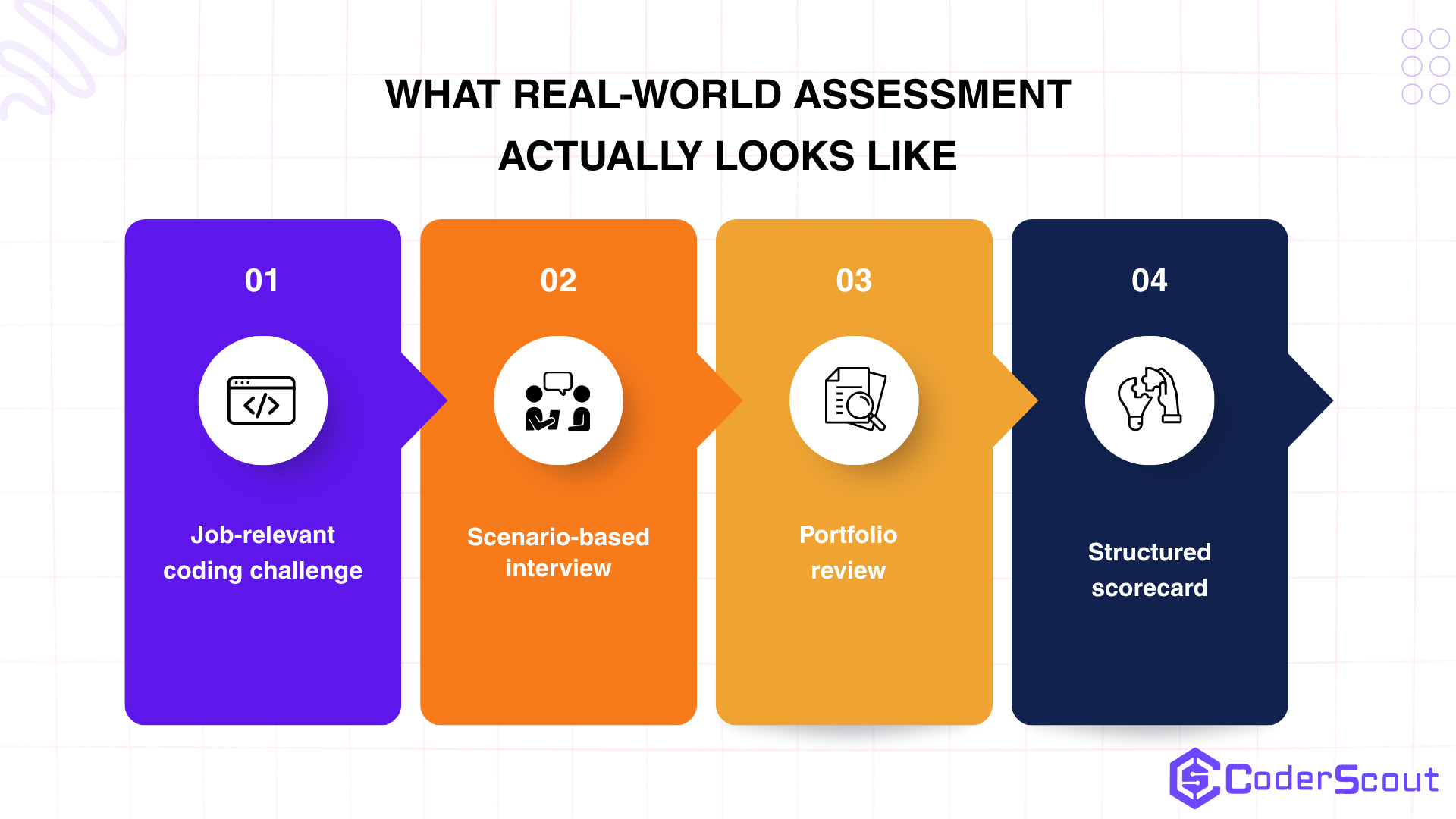
"Real-world assessment" isn't a single method. It's a category, and most strong pipelines combine two or three approaches rather than relying on just one.
Structured, job-relevant coding challenges replace the abstract algorithm puzzle with a problem that actually resembles the work: a real API to design, a data-cleaning task, a bug in a realistic codebase to track down. Candidates still work under a time box, but the problem itself is honest about what the job involves. That changes what's actually being measured. Not who memorized the most patterns, but who can reason through something they'd genuinely encounter on the job.
Take-home projects are another option some teams use in place of a live sprint, giving candidates a flexible timeline and access to the tools they'd normally use. They can be a strong signal, though they add real turnaround time for candidates and are worth reserving for roles where that tradeoff makes sense.
Scenario-based interviews swap the algorithm question for an actual workplace problem: "Walk me through how you'd debug a failing API," or "Describe how you'd optimize a SQL query." These conversations reveal troubleshooting process, communication under real pressure, and how a candidate thinks when the answer isn't already known to the interviewer.
Portfolio review works well for candidates with existing projects: open source contributions, side projects, prior work samples. It shows sustained effort, code quality, and decision-making over time in a way no 45-minute interview can, and it's one of the few methods that rewards candidates who took a nontraditional path into engineering.
Across all of these, what's actually being evaluated shifts. Not just whether the candidate arrived at a correct answer, but how they approached an ambiguous problem, how they'd explain a tradeoff to a non-technical stakeholder, and whether their code is something a team could actually maintain.
Why Soft Skills Can't Stay an Afterthought
Soft skills aren't a "nice to have" layered on top of engineering ability. They're a load-bearing part of whether a technically strong hire actually succeeds.
LinkedIn's Global Talent Trends report, as reported by HR Dive, found that 92% of hiring professionals now consider soft skills equally or more important than hard skills. More telling: 78% of employers have hired a technically strong candidate who ultimately underperformed because of a lack of soft skills or cultural fit. That's not a small minority of hiring mistakes. That's a majority of employers who have watched a technically impressive hire fail for reasons an algorithm interview would never have caught.
This is exactly the blind spot that real-world assessment is built to close. A scenario-based interview reveals how someone communicates under pressure. A coding challenge shows how someone documents their own reasoning. A portfolio review can surface mentorship, collaboration, and how someone contributes to a shared codebase over time. None of that shows up in a LeetCode score.
The skills that matter most in practice, clear communication (especially across distributed teams), genuine collaboration, adaptability as tools and requirements shift, and the judgment to know when to ask for help, are exactly the things a 45-minute algorithm interview is structurally incapable of measuring.
The Data: Does This Actually Work?
The short answer is yes.
Skills-based hiring has become mainstream, with 81% of employers using some form of it in 2024, up from 56% in 2022. Companies are increasingly adopting structured assessments because they provide a stronger signal of job readiness than resumes or algorithm-heavy interviews alone, according to the same report covered by The HR Director.
The impact is reflected in real hiring outcomes. IBM's "New Collar" hiring initiative, documented by the IEEE Computer Society, shows how a major employer put this into practice: by 2020, IBM had filled 15% of its U.S. job openings with candidates who lacked a four-year degree but demonstrated the necessary skills, broadening its talent pool while reducing hiring costs and time-to-fill. Similarly, LinkedIn's Economic Graph research shows that shifting to a skills-first approach can expand an employer's addressable talent pool by up to 10 times globally, demonstrating how job-relevant, skills-based evaluation can improve both hiring quality and hiring efficiency.
No assessment is perfect, but the direction is clear: when hiring focuses on demonstrated skills instead of interview performance, companies build stronger pipelines, make better hiring decisions, and spend less time interviewing candidates who aren't the right fit.
Building This Into Your Pipeline
Knowing that real-world assessment works is one thing. Running it consistently, at volume, without turning every hire into a bespoke research project, is the actual challenge most hiring teams run into. This is where a purpose-built platform earns its place, rather than trying to stitch the process together out of spreadsheets and ad hoc reviews.
Start with the problems your role actually involves. Before choosing an assessment method, get specific about what the job requires day to day: debugging speed, system design judgment, SQL and data handling, API design, clear communication with non-technical stakeholders. CoderScout's programming challenges, SQL and data engineering tasks, and REST API challenges are built around exactly this principle. Candidates solve problems that mirror the actual shape of the job, not an abstracted puzzle.
Combine technical and soft-skill signals in the same pipeline. Since a majority of failed technical hires fail on soft skills rather than code quality, an assessment process that only tests the former is only solving half the problem. Pairing coding challenges with communication skills assessments and AI-powered technical interviews gives a fuller picture before a candidate ever reaches a hiring manager's calendar.
Standardize scoring so it isn't left to individual reviewer judgment. Consistency across reviewers is one of the most reliable ways to reduce hiring bias and make outcomes defensible after the fact. CoderScout's structured evaluation templates and scoring frameworks are designed to make every candidate's technical and communication performance comparable on the same rubric, rather than dependent on whoever happens to be reading the submission that day.
Let human judgment happen last, not first. Once a candidate has demonstrated real ability, human interviews become far more valuable, because they're spent evaluating team fit and communication style rather than re-deriving whether the person can code at all. This is the same principle behind CoderScout's approach across both technical and non-technical hiring: screen for relevance, validate skills, evaluate consistently, and interview once there's already evidence to talk about.
Addressing the Objections
But we need to test under pressure.
Real jobs do involve pressure: production incidents, tight deadlines, high-stakes launches. But that's not the same as the artificial pressure of a live coding interview with no tools and a stranger watching. A job-relevant coding challenge or scenario-based problem tests real pressure: managing scope, making tradeoffs, and delivering something usable in a fixed window. That's closer to the actual job than a whiteboard sprint ever was.
Algorithms still matter for some roles.
They do. For roles like systems performance engineering or certain data science positions, algorithmic fluency is closer to a core job requirement than a proxy for one. The point isn't that algorithm knowledge is worthless everywhere. It's that for the large majority of engineering roles, it's being used as a stand-in for competence it doesn't actually predict.
The Bottom Line
For years, technical hiring has optimized for one question: Can this candidate solve an algorithm puzzle under pressure? But that's rarely the question employers actually need answered.
The real question is: Can this person build software, solve real problems, collaborate with a team, and make sound technical decisions?
That's why skill-based hiring continues to gain momentum. Instead of relying on resumes and whiteboard puzzles as proxies for ability, companies are increasingly evaluating candidates through job-relevant coding challenges, practical assessments, and structured interviews that reflect the work they'll actually do.
Algorithm knowledge still has its place for specialized roles. But for most engineering positions, real-world problem solving is a far better predictor of success than memorizing interview patterns.
With CoderScout, teams can replace algorithm trivia with real-world coding challenges, SQL and API tasks, and structured communication assessments, then evaluate every candidate against the same consistent rubric before a single human interview is scheduled.
Sources
- Turing, The Cost of a Bad Hire
- CareerBuilder bad-hire cost survey, via Apollo Technical
- JDP interview anxiety survey, via StandOut CV
- Skills-based hiring adoption report, via The HR Director
- LinkedIn Economic Graph, skills-based hiring talent pool research
- LinkedIn, Global Talent Trends report on soft skills and hiring outcomes, via HR Dive
- IBM "New Collar" hiring initiative, via IEEE Computer Society