As Applicant Pools Grow, Hiring Needs Better Signals

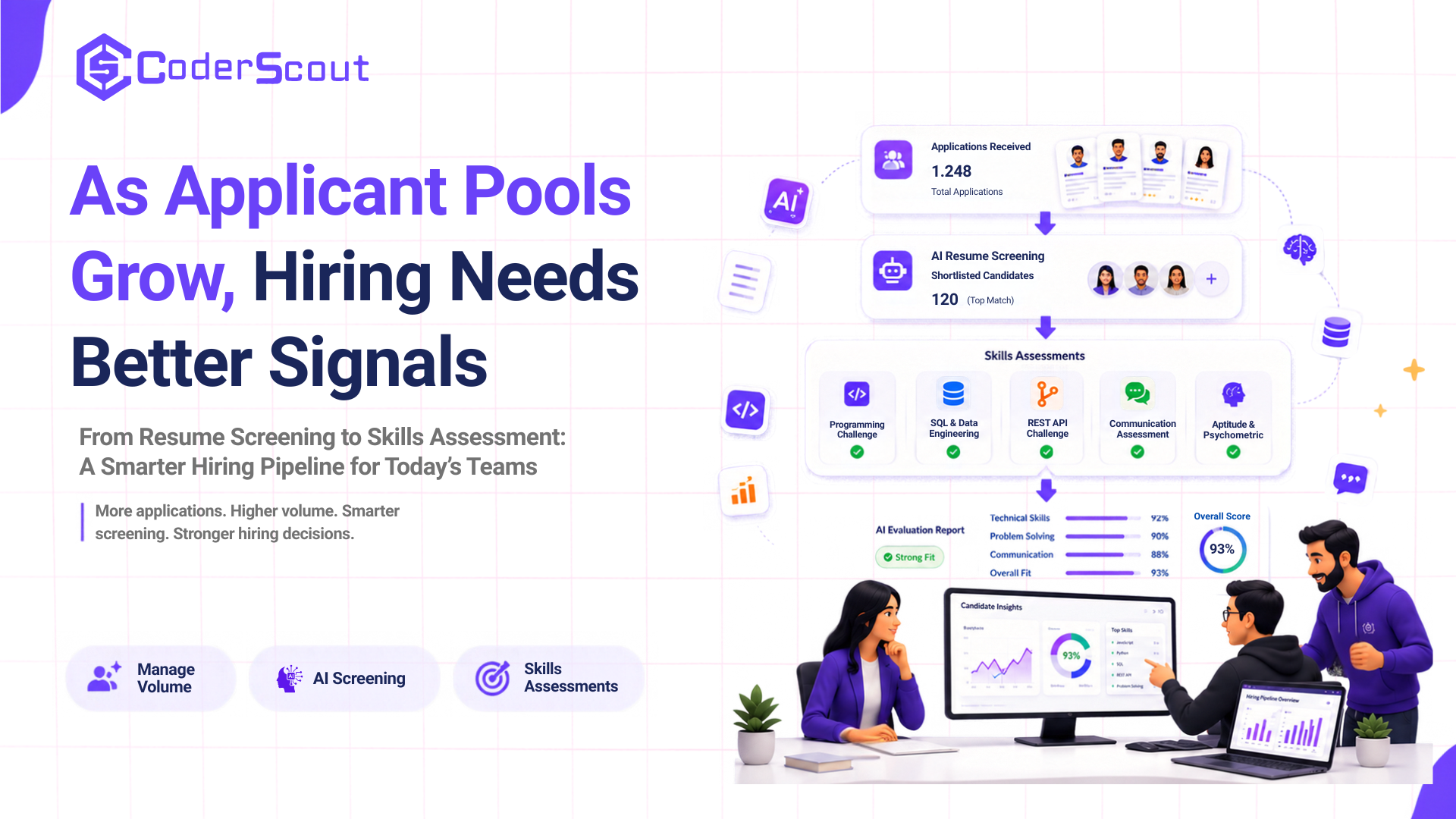
Post a job today, and applications don't necessarily trickle in; they can arrive in the hundreds within days. By the time a recruiter starts reviewing the pool, an AI resume screener may already have done the first pass, cutting hundreds of applications down to a smaller group worth a closer look.
That's a direct response to a hiring market where application volume has become harder to manage. Resume screening is doing more of the early-stage work, but that raises a bigger question: once screening has narrowed the pool, what should happen next?
Why Screening Has Become the Front Line of Hiring
The scale of the shift shows up clearly in how employers have adapted. The World Economic Forum reports that approximately 88% of companies already use some form of AI for initial candidate screening. As application volumes grow, AI is increasingly being used to handle the first pass through large applicant pools, narrowing the field before recruiters spend time on deeper evaluation.
This isn't a narrow pattern. LinkedIn's research found that 66% of recruiters globally say it has become harder to find qualified talent over the past year. In India specifically, applications per job opening have more than doubled since 2022, while 74% of recruiters say finding qualified candidates has become harder, according to LinkedIn research reported by Indian Express.
Put together, that's a real mismatch worth paying attention to: more people are applying, and recruiters aren't finding it easier to fill roles. That doesn't mean resume screening is failing. It means the volume of work resting on that first layer has grown substantially, and it's worth asking what else a pipeline needs once that first layer is carrying this much weight.
The Part Screening Alone Was Never Meant to Solve
Even well-run screening answers a specific question: does this candidate look relevant, based on the experience and skills described in their application. It doesn't answer a different, equally important question: can this person actually do the work. Those two things aren't always the same. A candidate with a work-history gap, a non-traditional background, or credentials that don't map neatly onto a job description can look like a weak match on paper while still being someone who'd do the job well. A screening process focused primarily on relevance can miss those candidates.
That makes the case for a two-layer pipeline: use the resume to establish relevance, then use a role-relevant assessment to gather evidence of demonstrated ability. That's not a case against screening. It's a case for pairing it with something that answers the question screening was never built to answer on its own. The point isn't that AI screening is sufficient on its own. It's that screening and assessment answer different parts of the evaluation problem.
What Candidates Want From the Process
There's a second reason a two-layer approach matters, and it has less to do with accuracy and more to do with trust. A Pew Research Center survey of U.S. adults found that 71% opposed AI making the final call on a hiring decision, compared with just 7% in favor. Views on AI reviewing applications earlier in the process were more mixed, 41% opposed, 28% in favor, and the rest undecided, suggesting candidates are more comfortable with AI doing a first pass than with AI owning the final decision outright. Even so, 66% said they wouldn't want to apply to a job at all if they knew AI was helping make the hiring decision.
The pattern behind those numbers points to something worth designing around: candidates can be uncomfortable with AI playing an opaque or decisive role in hiring, particularly when they don't see where human judgment still fits into the process. A pipeline that's upfront about what each stage is actually checking, relevance first, then demonstrated skill, gives candidates a clearer explanation of how they're being evaluated than an opaque single-step process.
What a Smart Pipeline Looks Like in Practice
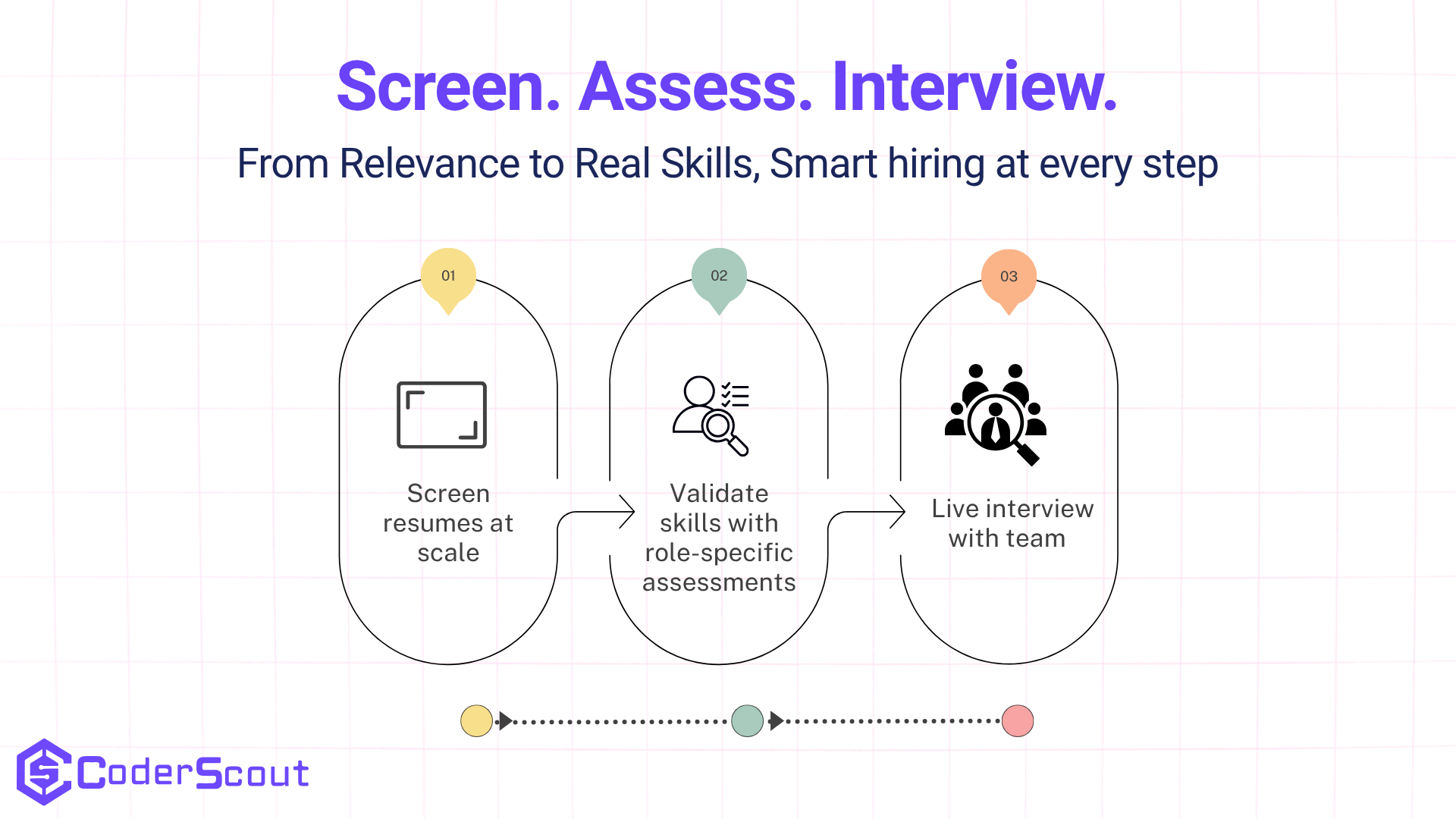
CoderScout can be used to implement this two-layer approach: resume screening to establish relevance, followed by a role-specific assessment to provide evidence of capability. Here's how the two layers can work together in practice:
Let resume screening do what it's good at. AI Resume Screening is built for exactly the problem described above: taking a large, fast-growing pool of applications and narrowing it down to candidates worth a closer look, quickly and consistently, without asking a recruiter to read every application by hand.
Add a skills layer for the roles where it matters most. Once a shortlist exists, Programming Challenges, SQL and Data Engineering tasks, and REST API Challenges give recruiters direct evidence of how a candidate performs on a specific, role-relevant task, evidence that complements what the resume already established about relevance.
Extend the same logic to non-technical roles. Aptitude Assessments test reasoning and problem-solving directly, and Communication Skills Assessment evaluates how someone actually communicates. Psychometric Tests add a different kind of context, measuring constructs such as cognitive ability, personality, and behavioral tendencies. These can provide context for role-related traits, but they aren't a direct measure of job performance.
Handle the moments where volume peaks hardest. Walk-in drives and off-campus hiring events are where application volume can become especially difficult to manage, with large numbers of candidates moving through the process in a short period. CoderScout's Walk-in Drives and Off-Campus Drives solutions can support these high-volume workflows by digitizing registration, assessments, shortlisting, and candidate progression in one process.
Putting It Together
Resume screening helps hiring teams handle volume and identify candidates whose experience appears relevant to a role. A role-specific assessment adds another signal: how candidates perform when asked to demonstrate the skills the role actually requires.
The point isn't to replace one with the other. It's to use each at the stage where it provides the most useful signal. Screening helps narrow the pool; assessment helps add evidence to the shortlist.
As application volumes continue to rise, that combination gives hiring teams a way to move quickly without making the resume carry the entire burden of evaluation.
Sources
- LinkedIn, LinkedIn Research: Nearly 80% of People Feel Unprepared to Find a Job in 2026
- Indian Express, LinkedIn report: 2026 hiring market, AI and application trends in India
- Pew Research Center, Americans' Views on Use of AI in Hiring
- World Economic Forum, Hiring With AI Doesn't Have to Be So Inhumane